
Pardon?

It can be dangerous to seize the moral or social high-ground. But it’s what institutions and their representatives do for a living.

Take the venerable Church of England. It gets its ecclesiastical underwear in a tangle every time a social norm is challenged, trying valiantly to remain relevant. Divorce, same-sex partnerships, gender-switching – and now women’s rights. Guess what! Equal pay is a distant dream for female staff at Head Office! Come on, Justin.

And on the day when British society’s top dog conducts his final public duty, the top people’s handbook flies in the face of decency and established principle. How? By declaring that the cognoscenti now accept the long-outlawed retort, ‘Pardon?’ when one mishears or seeks clarification. The Murican interrogative alternative, ‘Excuse me?’ has never gained acceptance in the face of the patrician, ‘What?’ and is now firmly removed from the contest by the plebeian and not-a-little-Gallic, ‘Pardon?’.

Both of these faux pas will acquire legs, I fear. Two referenda will be needed to help us decide what to do.
Baggage

I’m midway through my clan visits in the Green and Pleasant; now moved oop narth from Mid Sussex to West Essex (I can’t have you imagining me in Sarfend, can I?). So I’m very aware of the airlines struggle to squeeze maximum cash out of their no-doubt-tight-fisted passengers.

The pressure on cabin shelf space is inadequate for all the ‘free’ hand bags – the airlines admit it – but despite that, some charge significant sums to stow bags in the hold. On my trip here last week the passengers were invited to volunteer to have their hand luggage stowed below – free, of course. When insufficient numbers cooperated, a number of bags were seized whether their owners approved or not! Of course this treatment is meted out on those who decline to pay for ‘priority’ status only.

The latest nonsense is that Ryanair have now ordered new aircraft for 2019 with 8 or 9 more seats but only room for 2 or 3 more bags.

The race for low fares has ended in tears for both the carriers and the carried, it seems – with no hope of the worst culprits getting together to find better ways to price their services. Ho hum.


The ties have it

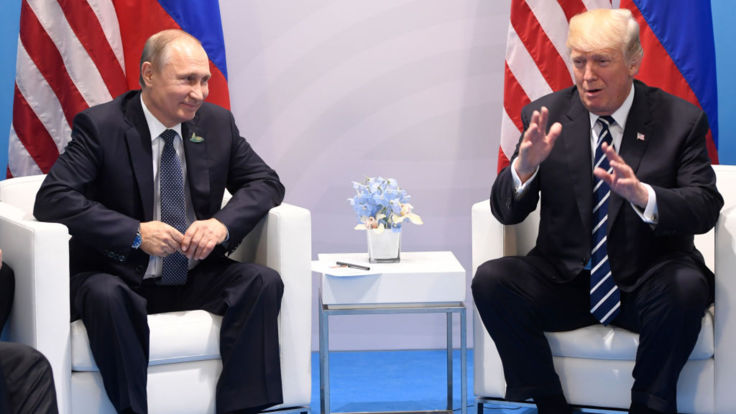
As a long-time tie-sporter, I invite you to spot every ‘tell’ revealed by the two bossmen’s neckwear.

The choice: Don’s says he’s the one. A faux-regimental or wannabe academic flourish? Vlad positively conservative.

The knot: A full Windsor each – the only way for any chief.

The length: Both afraid of a half-mast solution.

The tuck: Don letting it all hang out, Vlad avoiding any stray egg and soup.

The tie talk: Reticent smile vs. Brash bravado. Says it all.

The spare

One’s children cannot all have the Big Job. Since the cradle the Heir’s siblings have known they would be onlookers in history – although George VI had to step in from the bleachers when his brother succumbed to his flaws. And George was not a classic example of the more extravert, younger upstart – yet another of Fate’s ironies. Perhaps that epithet fits Margaret and Andrew better. And Harry, who clearly wishes to kick over the traces and feels frustrated by his obligations.

To misquote the NT: the royal family is in the world but not of it. But since WWII they have gradually accepted and even sought a more public rõle, to try to keep in step with other changes: the weakening class divisions, global travel, television, the internet, social media……and the cult of celebrity, with their total exposure and lack of privacy. And the Spares have naturally claimed more freedom to roam, attracted more media attention for their trouble and agonised over the ambiguity of it all.

No novelist could have invented Harry’s story. He ticks every psychological and social box and will probably continue to keep us enthralled. It’s what spares do.


One of those voices

Entertainment in the ’50s and ’60s was all about sound, not so much about images. The wireless played a leading rõle in family life, with the morning pips reminding us we were already late, the evening news gathering us together at 6 o’clock and favourite programmes on weekdays and at weekends. And in our house the cricket coverage was eagerly awaited, especially the voice of John Arlott.

So it was probably my generation of listeners who first welcomed what is now known as TMS; a sporting institution. Down the years Brian Johnston (sans the ‘e’) and his younger pupils have bemused and amused us every year.

But Henry Blofeld has been a star in the firmament, with erudition and wit we should hardly expect from a mere sport programme. And now he too is going to retire.

Thank you, Bloers!

The dance begins

As ever the meeja think the Brexit talks are a tennis match. Wrong. It’s more like chess. Sacrificing a pawn opens up new possibilities. Remember M Barnier has so many masters to serve, while David Boyo has a clear mandate: to do the best for the UK. While the cynics sneer, he can make concessions and win territory without the serried ranks of Europrats second guessing him. Give it time, friends!

Why didn’t I think of that?

Victor Orban, PM of Hungary, wants secondary schools to be equipped with shooting  ranges – to nurture Olympic champions but also to instill patience and concentration – according that is to the Times.

What a wonderful idea! Forget boxing and the martial arts, let’s get military – and why not throw in a few knife-fighting skills too? Then the public school system will be able to make sure all the potential thugs and terrorists have a proper grounding in murder and can succeed in their chosen professions.

I’m surprised the grand old US of A didn’t think of it first (or did they?). It would make a perfect social fit. I can’t wait for Trump’s tweet.


Time for others

By coincidence, after I’d seen many reports of people going the extra mile during the latest terrorist outrages, I saw an article in the Beeb’s travel pages about a Greek word nobody, even Greeks, can translate satisfactorily. It’s ‘philotimo’ (from the ancient Greek φιλοτιμία which appears in Homer and Pindar). Down the centuries the meaning segued from ‘ambition to impress’ to ‘altruism’ and ‘doing the right thing’ and these days seems to hover somewhere in between those apparently contradictory concepts.

Did the ancients see a connection there, I wonder. Did they reckon acts of kindness might be motivated, perhaps subconsciously, by a desire to appear virtuous, a wish to deserve praise?

Anyway, see what you think! Just askin’.

http://www.bbc.com/travel/story/20170605-the-greek-word-that-cant-be-translated