On this Day 66 Years Ago.

July 16th 1945.

At 5:29:45 am at a place in Central New Mexico already known as “Jornado de Muerto” (Journey of Death) Richard Feynman, barely 27 years old, removed his protective glasses because he doubted anything would happen, he saw nothing of the event but a purple blotch on the floor of the armored vehicle he was in.

I. I. Rabi said later “It blasted, it pounced it bored its way into you”

There was a crack like a rifle shot which startled a New York Times reporter, “What was that!” he shouted. “That’s THE THING!” replied Feynman.

Nearby, Enrico Fermi tore pages from his notebook into quarters and dropped them slowly from his hand, mentally calculating the strength of the pressure wave from the fluttering leaves.

Feynman at last could see, and what he saw were clouds “What have we done to make clouds in the desert?” was his first thought.

Robert Oppenheimer quoted the Bhagavid- Gita
“Now I am become death, the destroyer of Worlds”
He was closest to the truth.

The experiment was code named TRINITY and was the defining event of the 20th Century.

Within three weeks the two other bombs then in existence were exploded and the childhood of mankind was over.
How to Acquire an Australian Accent

I was planning to post a blog about crabs and oysters today and had made some progress towards getting it straight when Donald’s post advising Mr. Mackie about acquiring some proficiency in Strine reminded me of a happening from many years ago, it has something to do with oysters albeit indirectly and may have a significant bearing on Mr. Mackie’s endeavour.

Many years ago when my old dad was still alive, he and my mother came to visit us in Maryland, he and I decided that we would take a couple of days on our own and sail down the Bay visiting a few fishing places en route. A few days after setting out we were a hundred miles or so down the eastern shore and stopped for a night at the town of Tilghman on Tilghman Island. This quiet little place is the home port for ten or twelve skipjacks, wooden boats of forty or fifty feet in length employed in the oyster dredging business and one of the last fishing fleets powered solely by sail. Continue reading “How to Acquire an Australian Accent”

Captain Kidd’s Enduring Legend

My name was William Kidd, As I sailed, as I sailed,
My name was William Kidd, When I sailed,
My name was William Kidd; God’s laws I did forbid,
And so wickedly I did, As I sailed.

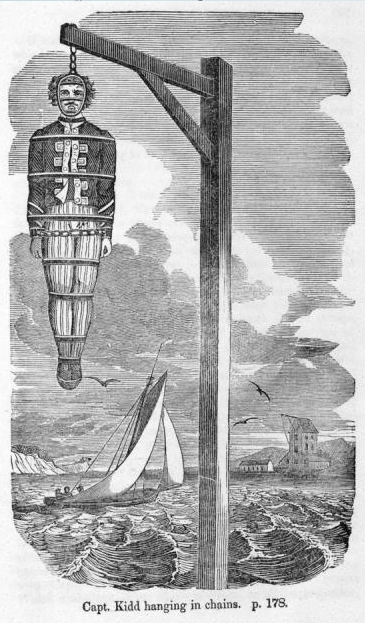
We’ve not long passed the three hundred and tenth anniversary of the execution of Captain William Kidd, by reputation one of the most notorious pirates who ever lived, of the Caribbean or any other of the seven seas.  Taken to Execution Dock in Wapping, he was hanged on 23 May, 1701, a particularly brutal event.  Twice the rope around his neck broke; the third time it held.

Afterwards, according to Admiralty custom, he was tied to a stake on the Thames Estuary to allow three tides to wash over him.  Not content with that, his bloated body was then dipped in tar and squeezed into an iron frame at Tilbury, there hanged anew as a warning to all future pirates.

The problem is William Kidd, for all the notoriety subsequently attached to his name, was not a pirate at all but a privateer, acting under licence at a time when Britain was at war with France.  That is to say, he was an ‘official’ pirate, whose plundering of enemy merchants had the sanction of the authorities, themselves party to a contract that promised a lucrative return in loot.  In the end he was betrayed in a shabby act of duplicity by the very people who had sent him out in the first place.

My interest in the subject was whetted by an article written by Angus Konstan in the June issue of the BBC History Magazine (The Sacrifice of Captain Kidd).  Taking this as my cue I did a spot of further research, coming up with some rather intriguing material. Continue reading “Captain Kidd’s Enduring Legend”

Oliver Cromwell v Charles 1 : Setting the Scene

Where to start? Firstly in writing this, my intention is not to try to write a biography of either of my two main characters, Oliver Cromwell or Charles I. Neither will I try to condense the events of the English Civil War into a few paragraphs. Rather my aim is to give you an idea of the causes, economic, political and religious, which led to Revolution and Regicide, and try to explain, not excuse, the actions and motivations of the two main characters, each representative of his background and interests. Most of my readers will no doubt have some knowledge of the period, but for a very easy guide to timelines, battles and short biographies this site may prove useful.

Continue reading “Oliver Cromwell v Charles 1 : Setting the Scene”

To Althea, From Prison

When I was a child, one of my favourite books was Children of the New Forest by Frederick Marryat. I must confess that from the age of eight I was firmly on the side of the dashing Cavaliers and Charles 1; and in many respects, I still am to this day!

So, whilst I am preparing an account of why he came to such a sticky end, and extolling the virtues of Oliver Cromwell, you might enjoy this poem by one of the “Cavalier Poets”, Richard Lovelace, set to music by Fairport Convention.

To Althea, From Prison

Richard Lovelace 1642

When love with unconfined wings
Hovers within my gates;
And my divine ALTHEA brings
To whisper at the grates;
When I lye tangled in her haire,
And fetterd to her eye,
The birds, that wanton in the aire,
Know no such liberty.

Continue reading “To Althea, From Prison”

Limiting Power

Further to the discussion on the monarchy, parliament and democracy, I thought I’d write a simple piece about the beginnings of Parliament. Needless to say, I couldn’t keep it simple – or short! But, for those interested here’s the first part of my take on the beginnings of England’s progress down the democratic path to the Westminster System … Read more – but this is really long!

24th April 1944.

Cassino Railway Station Royal West Kents.

At that time, it would appear, that the 5th Battalion D Coy were holding positions around Cassino Railway Station. They were the only company in close contact with the enemy. Another company was one mile further back and the remainder of the battalion further back still. The railway embankment was covered by the fixed lines of fire by the enemy. Because of this, rations were only taken every third night by tanks. The rations were placed in sandbags – one bag for each two-man weapon pit and the sandbags were slung round tanks which drove along the embankment and around the station positions dropping them off as required. Continue reading “24th April 1944.”