In 46 BC Julius Caesar reorganised the calendar with months at fixed lengths, one year had 365 days, 12 months and every 4th year was a leap year with 366 days. To return the public feasts to their correct seasons an additional month was inserted in 46 BC which was called the “Year of Confusion” since it consisted of 445 days – and on 1 January 45 BC the Julian Calendar came into effect. But the Julian calendar did not account for the fact that a solar year is not quite 365 and a quarter days.
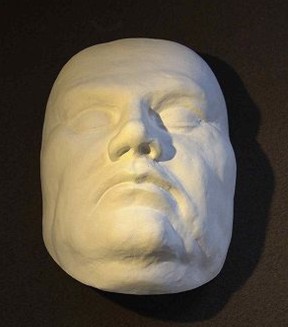
On the 18th of February 1546, Martin Luther died in Eisleben.
Now according to David Starkey (who was my tutor when I learnt all this stuff) Martin’s big problem was constipation, which made him extremely irritable – especially with indulgence sellers….
The 14th of February 1400 is allegedly the day that Richard II, last of the Plantagenet Kings, died in Pontefract Castle. The cause of death is said to have been starvation.
Richard was born on the 6th of January 1367 in Bordeaux. He was the second son of Edward, the Black Prince, and Joan, later known as the ‘Fair Maid of Kent’. Richard’s grandfather, Edward III, and his father were renowned soldiers.
Richard’s elder brother died in 1371, by which time his father was already an invalid. The Black Prince died in June 1376, leaving Richard, aged nine, as heir to the English Crown.
By 1377, Edward III was also an invalid and declining into senility. He was unable to open the last Parliament of his reign in January 1377, and Richard stood in for him on the opening day.
Edward III died on the 21st of June 1377, and Richard was crowned just eleven days later. Richard swore the, by now, traditional oath to uphold the laws and customs of his ancestors, to protect the Church and the clergy, to do justice to all and, finally, to uphold the laws which the people would ‘justly and reasonably’ choose. He was carried shoulder high from the church and in the process lost a shoe. This was later described as a ‘bad omen’. Continue reading “On This Day – 14th February 1400”
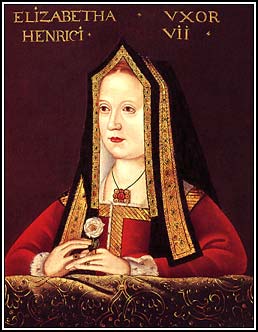
On the 11th of February 1465, Elizabeth, the first child of Edward IV and his wife Elizabeth Woodville, was born at Westminster Palace, London.
Elizabeth already had two legitimate step-brothers; her mother was a widow when she married Edward, and possibly a few illegitimate siblings as well – Edward was a notorious womaniser!
Like most princess at that time, betrothals were made, and discarded to suit the political aspirations of the king. Unusually, Elizabeth’s first proposed match was with a Duke of the Realm, the Duke of Bedford. That was set aside, and Elizabeth was betrothed to the Dauphin of France, who broke off the arrangement when Elizabeth was about 16. Continue reading “On This Day – 11th February 1465 and 1503”
Well over 25 years ago I thought I’d spend a little time researching my family history – a bit of light relief from Economic History! It wouldn’t take that long, I thought. I just wanted a rough outline of where my ancestors originated from, who they were and, perhaps, what they did…
On the 8th of February 1555, Laurence Saunders, preacher and rector of All Hallows in London, was burnt for heresy in Coventry. He was the second of the 284 ‘Marian Martyrs’ to die between 1555 and 1558.
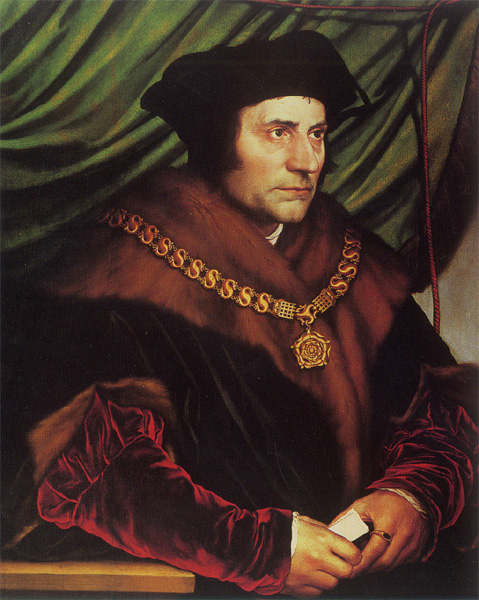
Some time between 2 and 3 on the morning of Saturday the 7th of February 1478, Thomas More was born in Milk Street London. He was the only surviving son of Sir John More, a lawyer, and Agnes Graunger. Thomas described his family as being ‘non celebris sed honesta’. Thomas was to change that…!
Thomas was educated at St Anthony’s school in Threadneedle Street, and at thirteen he was placed in the household of Thomas Morton, Archbishop of Canterbury and Lord Chancellor of England. On the Archbishop’s recommendation, Thomas was sent to Oxford. Apparently Thomas’s father kept his son short of funds so that ‘he had no opportunity of neglecting his studies for frivolous amusements’. Some of us can’t imagine Thomas as being ‘frivolous’, but he was described as a ‘merry fellow’! Continue reading “On This Day – 7th February 1478”
Every year on the anniversary of the opening of my school, we were read extracts from the memoirs of one of the twelve girls who were there in 1880 on the very first day. One story was about a girl who had entreated her father to send her to school so that she could get a ‘proper education’. Her father agreed, reluctantly, and said that he had no objection to her being educated, providing she wore her skirts long enough to hide her blue stockings.
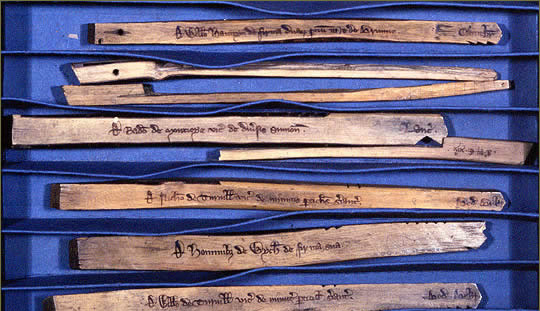
Tally sticks were a medieval accounting device: a peg of wood (usually Hazlewood) was notched with cuts of varying sizes for each denomination of money. It was then split lengthways down the middle into two pieces of unequal length so that each piece had the same notches.




 Boadicea's Chariot
You must be logged in to post a comment.