It’s raining again! I’ve had it with spinning and knitting and the greenhouse is up to date so I am reduced to looking at old photos. I came across these from spring of ’08 that looked apt for the residences blog. NOT that I hasten to add are they part of the competition, that would never do!!! Just thought you might like to see them.
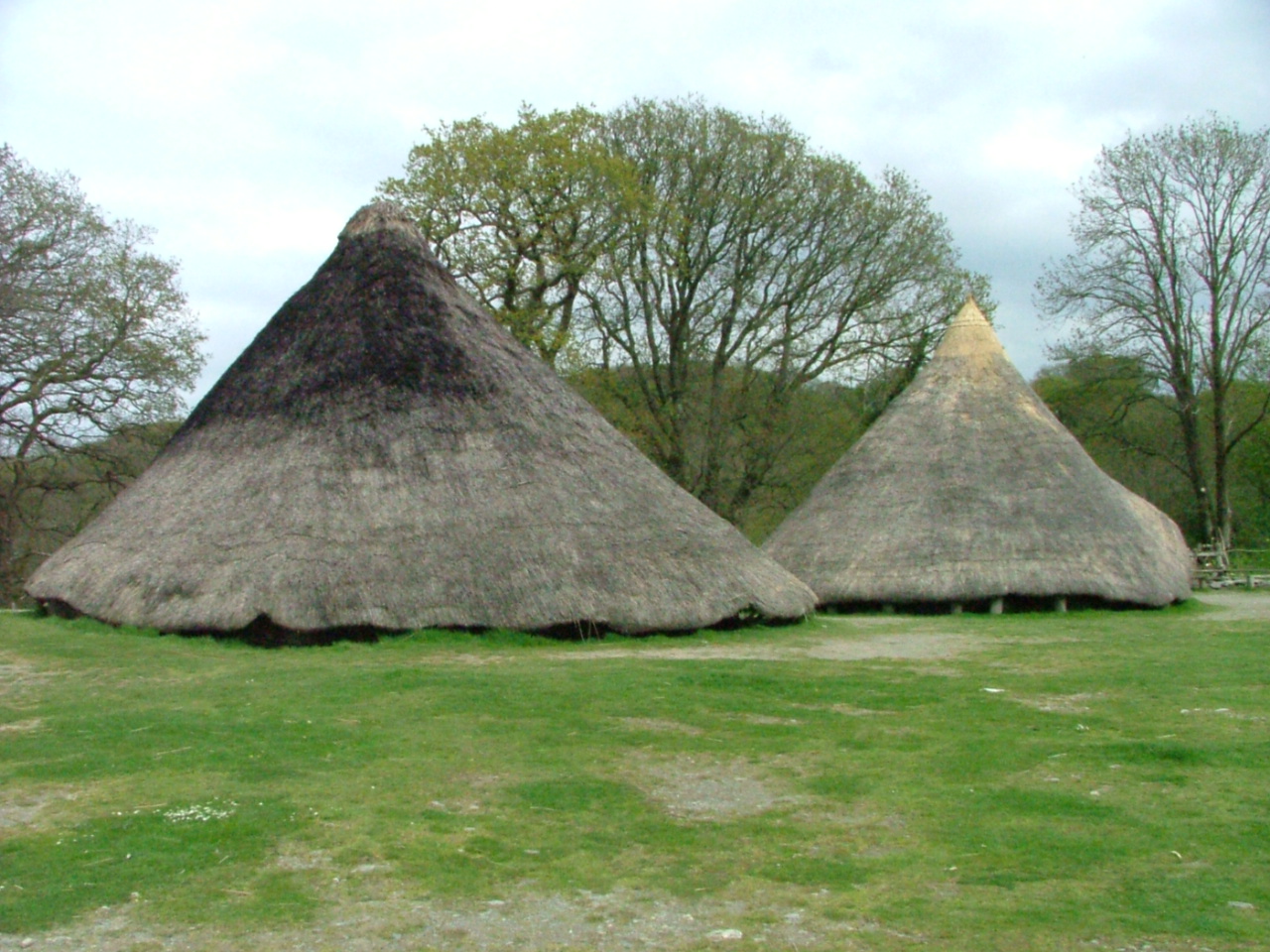
No! Not monster mushrooms, just your genuine brand new iron age des res. This is a tourist trap built in N Pembrokeshire on the site of an iron age fort. The buildings are supposedly actually built on the original sites using the original post holes etc to get the size and clustering of the community.

Actually they were rather cosy inside.
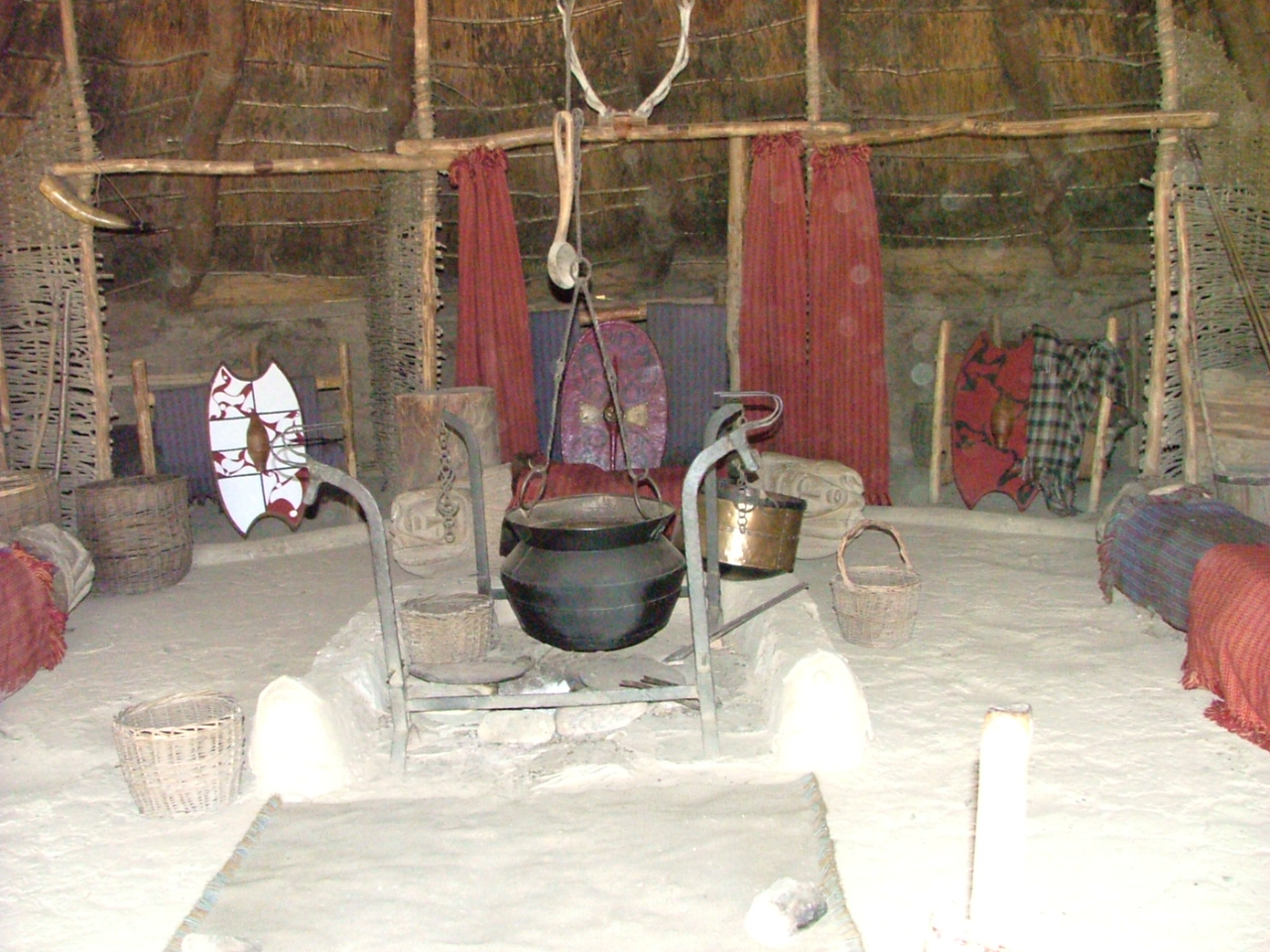
Several of them are fitted out with artefacts made to conform to archaeological finds on the site.

During the summer, people actually live there ‘doing’ iron age things etc (especially the etc!!)
They did not appear to be suffering any and all seemed to be having fun which is more than you can say for the 21st Century!
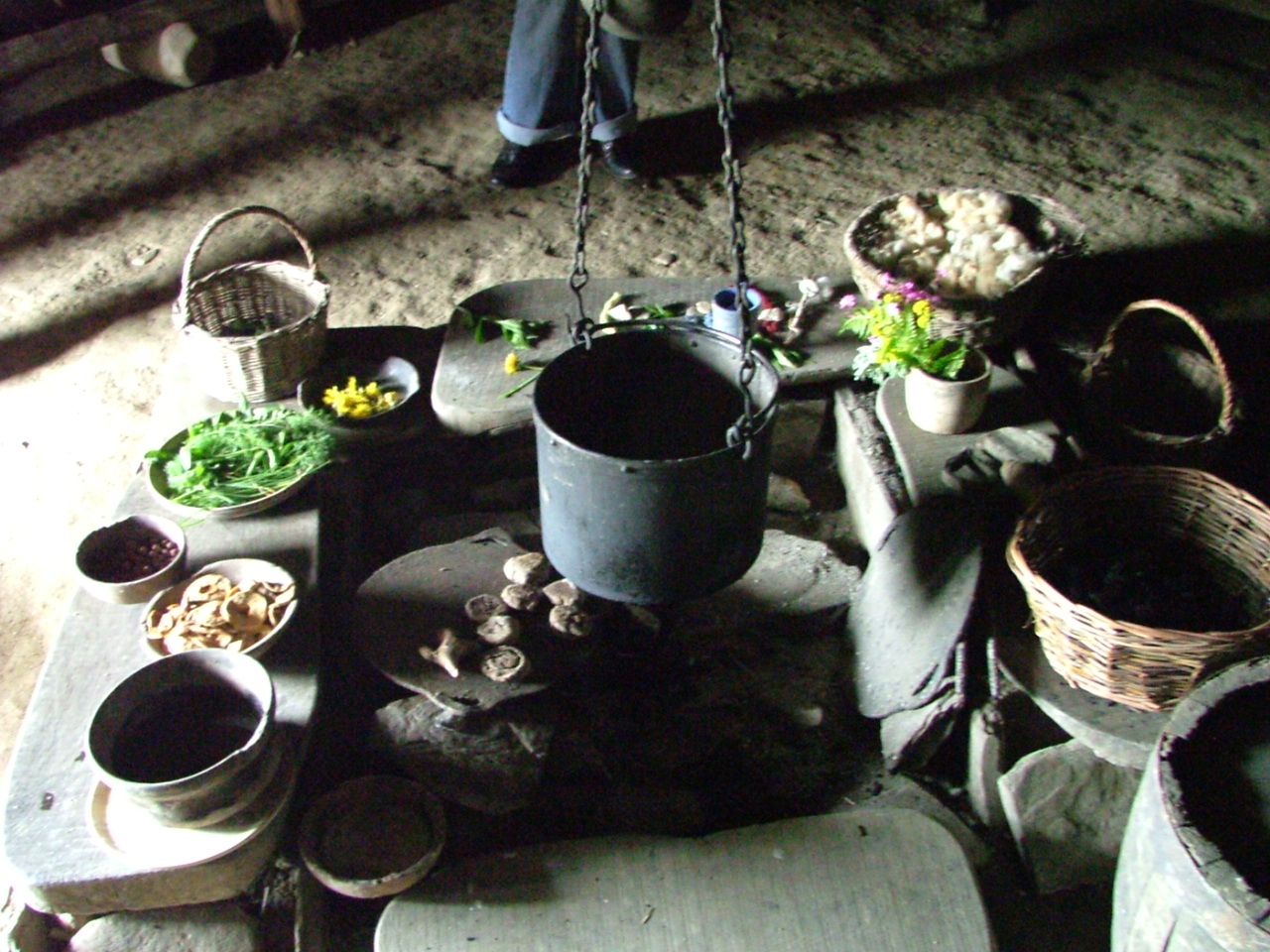
Dinner, supposedly from the woods, (looked more like Tesco plus a few weeds!

An iron age lathe, that actually did work providing you could keep treadllng the band.
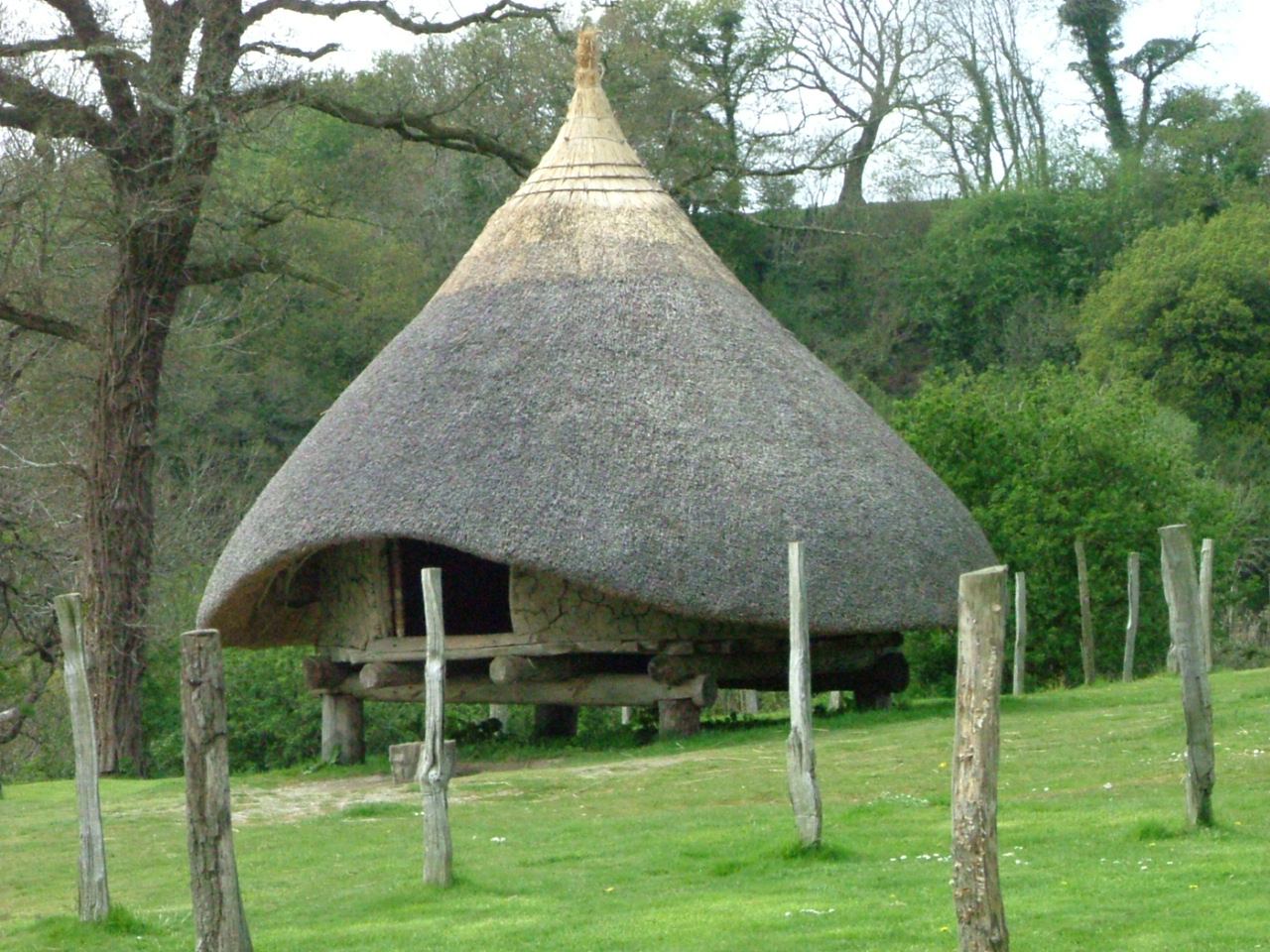
This was quite interesting. the store house for the community, built off the ground to keep vermin out of the stores.

Denizen of the fort keeping a beady slitty eye on invading barbarians.
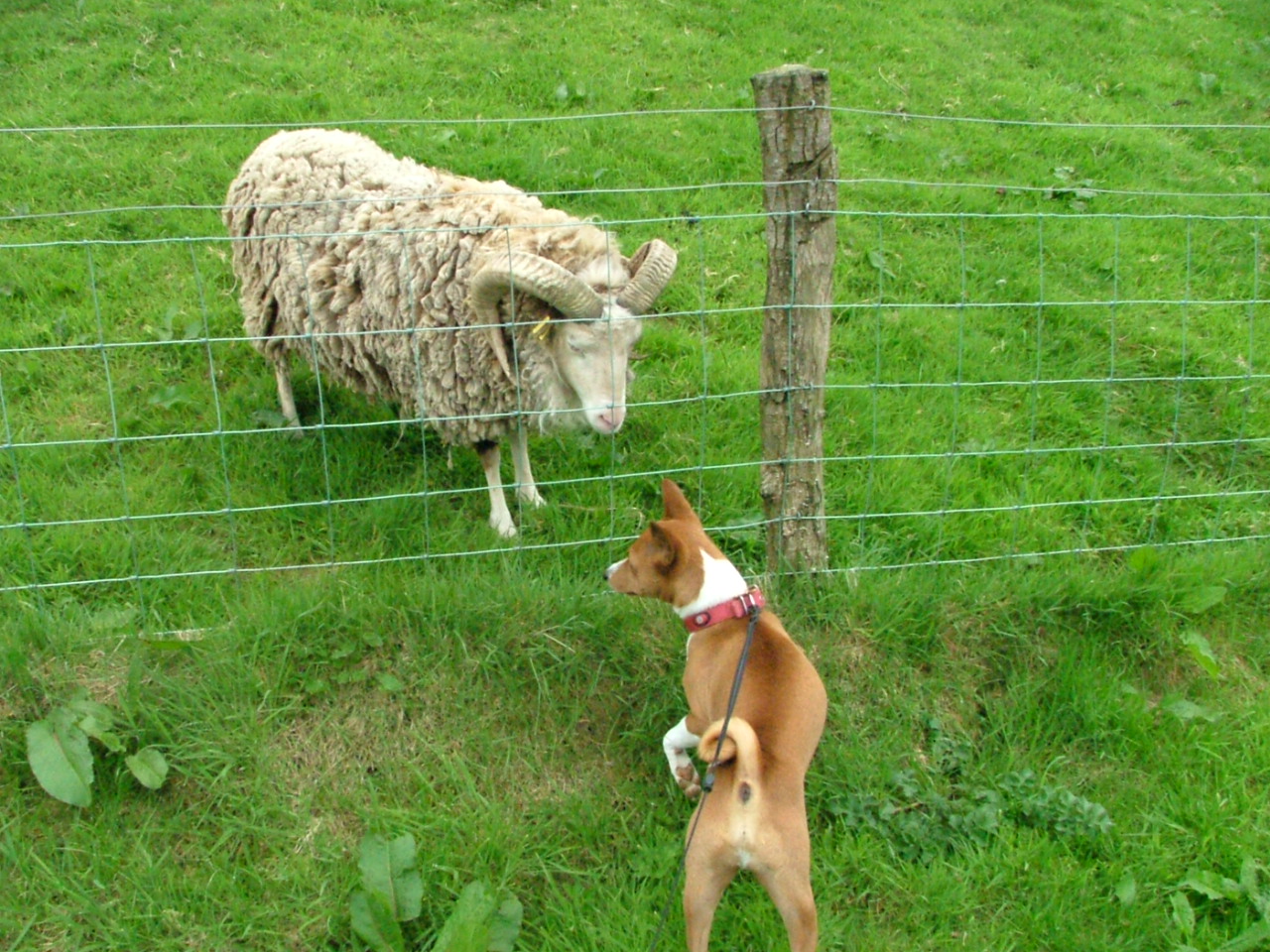
According to Nemo this one was a sacrifice, an iron age canine gift that he wasn’t allowed to collect (much chagrin!) All in all a good day out.
I t struck me that they did themselves very well. I suspect a lot better than some do today with the current price of fuel! I wonder if any of the indigent have moved in recently? I would if I were homeless, seen a lot worse!

 Boadicea's Chariot
How extremely interesting and well-illustrated, Tina.
Could I persuade you to just donate a couple of these photos for the competition? I appreciate it’s against everything you stand for and all that, but just to make up numbers. I’ll do the links and stuff. 😉
These pictures remind me a bit of central California indigenous structures, save for the looms. Most clothes in California were made of deer and rabbit. Interestingly enough people only had to work for about 6-8 hours a day which includes gathering food and cooking. Much more time left over for leisure and enjoying nature.
Christopher, I can inderstand ‘enjoying nature’ but what other leisure pursuits did they have? 🙂
Raiding for women, sleeping, and becoming more intimately familiar with their loved ones in the woods. A fair amount of hunting as well.
Ara, just knew that would happen, just don’t let me win!!!
Chris, I expect they were duplicated all over the world at roughly the same point in development of technology of the locals.
Janus, I presume the Welsh lot wove wool clothing knowing the climate. Knowing the speed of spinning using a spindle I expect that was a near full time job for some as it was right up until the 1700s. They made a lot of storage items, both basketry and wooden coffers. The iron age folk were very adept at jewellery too. Most of the museum pieces they have are a damned sight better made than the modern stuff!
PS a spindle is painfully slow compared with a wheel. It would take me a week-10 days full time to make enough wool to knit a jumper on a wheel, more like a month, if not longer, on a spindle which I really can’t be bothered with!
I’d like to believe they had a 6 – 8 hour ‘working’ day but my guess is they were ruled by the seasons and the light much more than we imagine. In winter the daylight hours had to be used for survival jobs like getting food and fuel and the indoors were probably very smoky, airless and dark.
PS I like the goat with the crumpled horns! 🙂
Sounds like my perfect day. 😀
OZ
Janus: it wasn’t that difficult. They had preserved meats and venison was plentiful even in the winter. Their diet was based on acorn meal and they built granaries for storing acorns over the winter. They would also move to lower elevations during the winter thus avoiding cold temperatures for the most part.
OZ: somehow I knew you would approve!
Lovely pictures Mrs. O. The Granary is a classic.
Janus: Both those goats are sheep. 🙂
That explains my biblical problems. 🙂
Beat me to it LW!
Jeez janus wot’s all this about not sorting sheep from goats?
There is a bit of an effort these days to keep rare breeds alive and kicking. Many farmers have a commercial flock and then a pedigree flock of 20 or so rare breed sheep as a hobby. It is a cheap excuse to career round the countryside in the summer taking them to shows and drinking!
I expect the fort had these examples to show what kind of sheep the iron age people had, (which they did) sheep were smaller then, had large horns and coarser coats. Obviously the original would be no longer available so they have picked a breed that is representative of the type. These are now rare breeds because they are not so productive of either meat or fleece. The Scottish Island sheep were nowhere near as bred as the mainland ones, they were often left to their own devices on islands and swam across periodically, they still are! Hence they are far more like their ancestors than English sheep.
The big horned black one is (I think) a Hebridean sheep, sometimes called a St Kilda. The white one I am not sure, but to have a stab at it most likely to be a South Wales Mountain sheep.
Modern hippies tend to build these kind of buildings still, get it right and it is not smoky at all, get it wrong and it is unusable! I had a colony of them just up the road from me in Cwmdu in Carms.
When I look at these sort of houses, I put my hands together and thank what ever God /Godess determined that I was born in a Western society in this century!
It all seems like too much really hard work simply to stay alive, warm, and well-fed!
Shame on you Bo, wot, no atavistic qualities?…..
Watching a couple of documentaries recently on Pompeï and Herculaneum, we were both struck by the thought that life in those times, just before Vesuvius let rip, must have been not dissimilar to today.
Frightening isn’t it? I have the hideous feeling that actually life is going backwards in development these days. The ubiquitous ‘they’ keep telling us that the Neanderthals died out a while back so why are there so many on the streets everywhere today?
I blame the parents. 😦
Oh! Dear! How can anyone really think that life in former times was similar to today?
Life without electricity / gas – lighting, heating, cooling and all the other things that need electricity to run? Not for me.
Life without pain killers for headaches, toothache and all other aches and pains? Suffer on, but count me out.
Life where women and children were mere chattels? Again, not for me – and, I think not for the females on this site.
Life where the only labour-saving devices were large numbers of enslaved humans? Great if you weren’t one of those slaves, but the chances are that you would be.
The most wonderful thing about living today is Leisure Time – the freedom to spend long hours doing things that I enjoy doing.
As I have said many, many times: I like to study history – I have no wish to live it.
🙂
Boa, yes. It’s too easy to forget that daily life among Romans was the ultimate example of ‘us and them’, the masters and the slaves, even closer than we are to ‘the state of nature’ (Thomas Hobbes) – “continual fear, and danger of violent death….solitary, poor, nasty, brutish and short”.
Cheers, Janus!
History has long been confined to the study of the few – the rich, the privileged and those at the top of the social tree. It has ignored the lives of the majority, who lived well below the poverty line, who had no rights and were subject to the whims of those above them and who struggled simply to stay alive.
Hollywood films about the past have not helped either.
If I had my way,the study of history would be compulsory. Not the sort of history that is biased towards a political agenda, but the simple facts of how most people (not just women!) lived – so that modern society understands just how far those at the bottom of the social scale have moved from the past, and put some effort into maintaining that improvement.
I’d particularly like for all politicians to study history so that they know that many of their so-called radical solutions have been tried before – and the reasons why they all failed…
Ah well! Dream on, Boadicea!
Boadicea: you might well be cheered up by studying the reign of Zhu Yuanzhang, or Ming Taizi. He was an orphaned farm boy whose parents starved to death before he became the founder of the Ming Dynasty.
He treated common people kindly and often pardoned people for showing signs of correction. His officials were penalised severely for even relatively minor infractions.
As old George Santayana said: “Those who cannot remember the past are condemned to repeat it”. 🙂
I have lived in several country houses where the electricity was not very reliable. It you are geared up to oil lamps, candles, and solid fuel heating and cooking it really is not at all inconvenient and very much more peaceful! (And yes, I had paid the bill for when it did happen!)
They have had painkillers for a couple of thousand years, herbal medicine has been around a long time!
In several societies women were equal to men, it was only when the Normans invaded that things went backwards in the UK.
I can’t actually see that the average slave in the past had it much worse than some ghastly denizen of some slum council estate. Good slaves were rather highly prized and often paid rather well with slaves of their own.
Anyway I don’t think it will be too long before we find out for ourselves. The way this world is going it would never surprise me if the electricity went off permanently!
At least the place then was not overpopulated.
Christopher – Zhu Yuanzhang, was one from millions who ‘made good’ – the other ‘many millions’ weren’t quite so fortunate!
Christina 🙂 – I’m a city woman! I lived with gas lamps, and (luckily) gas heating and cooking in the miner’s strikes – not an experience I would like to repeat! I can be pretty self-sufficient – but that’s not to say I enjoy the process…
When doctors ask me whether any of my family have had certain illnesses – I always reply “How far back do you want to go?” I can produce the death certificates of 99% of my ancestors (some of whom were born in the 1760s) dating back to 1837 – and I have another 300+ death certificates from one family of the same family.
Most of those who died before the 1920s died from illnesses that can be cured quite easily today.
Sure, women in pre-Norman times were not treated as mere chattels – and, as I understand it, women in Wales had considerably more rights and freedoms than their English sisters until the mid 1500s. But, never did any woman have equal rights to men.
The average slave in the past may have lived better then the ghastly denizens of some slum council estate – but those ‘ghastly denizens’ have the right to to order their own lives while no slave has that right and the slaves in Roman mines were simply worked to death.
No one will ever convince me that my life would have been better had I been born in any other time than now!
Having said that, I cannot argue with your last comment that the ‘ place then was not overpopulated.’ I’m happy that I won’t have to face the consequences of the determination of every country to ‘grow, grow, grow’.
Co, I too am afraid you see slavery though rose-coloured specs!