
In 2006 The Iconclast writing for The New English Review published an article on his web page with the exciting title , ‘Breaking news – English has a gerundive‘. I came across the article following a challenge to one of my comments on a MyT post from ‘beanbeab (stefa)’. This was some few years back, and I was always happy to have my use of English corrected by the now sadly departed and greatly missed beanbean. As I’m sure she suspected, my knowledge of the gerund (and I suspect that of most other people) was non existent. Either that, or buried in some long unopened memory vault. Nevertheless, my fleeting contact with beanbean did revitalise my interest in the English language. An interest that I now avidly pursue. In a recent parody I composed based on ‘Sea Fever by John Masefield’ , the following line became a real test for a bear of very little brain:-

“I must go down to the seas again, for the call of the running tide”
Running tide? A simple gerund, or perhaps a ‘gerundive’? But the gerundive is not thought to exist in the English language, or is it? The following is a blatant cut & paste of the 2006 exciting news from The Iconclast
Some exciting news from Dot Wordsworth in this week’s Spectator:
A creature so rare that its existence had been discountenanced has been discovered in South Africa. The creature is the English gerundive, a relative of the extinct Latin gerundive, and its discoverer is Jean Branford, the respected editor of A Dictionary of South African English. I had never believed in the existence of the English gerundive until now. Just to place it in its habitat, let us remember that:
1. The participle (Latin amans) shares properties of verbs and adjectives, as with reading, ‘the reading public’.
2. The gerund (Latin amandum) is a verbal noun, active in meaning, as with reading – ‘reading occupies Charles’ (where reading acts as a subject); ‘reading law journals occupies Charles’ (where the noun phrase is the subject of the sentence, and reading takes an object, law journals, in the noun-phrase); ‘Charles enjoys reading’, where the gerund functions as an object.
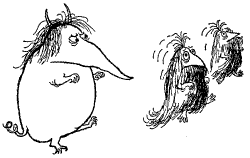
3. The gerundive (Latin amandus –a –um) is a verbal adjective passive in meaning. It is translated as ‘fit to be loved’, ‘fit to be read’, or ‘lovable’.It is easier to spot a part of speech if you know what it looks like. Fans of How To Be Topp, will have no trouble recognising a gerund, an aggressive, egotistical predator with a racy private life. Here a gerund attacks some peaceful pronouns.
This is in keeping with its active nature. The gerundive, as befits its role, is a puny, passive little thing. Below, the gerund, a social snob, “cuts” the gerundive, who meekly takes it on the chin.
No wonder it is all but extinct.
No gerundive was found to exist in English. But Dr Branford says, ‘What about reading matter? Or whipping boy?’ The form of the gerundive is in English the same as that of the participle, but then so are the forms of the participle and the gerund. The meaning of the gerundive is distinct from that of the gerund: distinguish reading room and reading matter, where the latter has a passive sense. Or distinguish whipping boy and whipping post. With whipping post or reading room, the gerund acts as a modifier, just as nouns can, in constructions such as violin case, dog whistle.
The newly discovered gerundive in chewing gum (‘chewing gum sold here’) is distinct from the gerund identical in form, (‘chewing gum is a horrible habit’). Other examples of gerundives from Dr Branford are stewing steak, cooking apples, bedding plants. Don’t forget that a passive element is present in the gerundive, so pickling onions include a gerundive (‘onions fit to be pickled’) but pickling spice (‘spice for pickling onions’) does not.In passing, Dr Branford notes that Kingsley Amis, in The King’s English (1997), gets the gerundive completely wrong. Homer nods. She also remarks that the great Henry Fowler’s ‘notion of the grammar of participles was at best hazy’. Fowler said that English does not happen to possess a gerundive. The late Robert Burchfield, in his revision of Fowler’s Modern Usage, notes that Latin does. Only now has the English gerundive, thanks to Dr Branford, been bred in captivity.
The distinction is clear. Chewing gum is gum that gets chewed. Stewing steak is steak that gets stewed. These are gerundives. Chewing gum is a bad habit. Stewing steak can take a long time. These are gerunds.
I am struggling to find further examples of the English gerundive, although I know they must be out there somewhere. By analogy with cooking apples, we have baking apples or eating apples, in the sense of apples to be baked or eaten rather than the activity of baking or eating apples. And there is whipping cream, that is cream for whipping. I started wondering about “writing paper”, but I think that is a gerund, meaning “paper where you write”, as a reading room is a room where you read.
This evening I will be attending a birthday celebration in the East End of London. I will be on the look out for gerundives and if I spot one I will catch it and drag it back home. It will make a good scratching post* for my cats.
*”Scratching post” differs from “whipping post”, because it gets scratched, while the whipping post doesn’t get whipped.

My first and only attempt at riddling, was that of trying to create a rhyming response to a challenging beanbean. Unfortunately, as we were to find out, beanbean died and so without a mentor I abandoned my riddling. Here I am some years later, still finding the gerund and the gerundive challenging.
The following is my attempt at riddling. Given the subject of this post, the only challenging thing left is in finding the two related words and where they are ‘hiding’!
I am not an elegant thing,
My suffixing has not the ring
Of linguae or linguam.
A verbal noun is not declined.
It is not like the Latin kind,
As Latinae or Latinam.
And; do verbal adjectives found,
Within two words that are compound,
Give under, subject to exam?
Chewing is something that is done,
But what is meant by ‘chewing gum’?
In short I have ‘lost’, an anagram.

 Boadicea's Chariot
The grammar is (or should be) a given. I have always been a huge fan of Molesworth and particularly of Ronald Searle’s drawings.
OZ
Surely the “running” as in “running tide” is a present participle used as an adjective. But in “The Holly and the Ivy” the “running of the deer” is a different matter, as is “the playing of the merry organ”.
This is one of those occasions where the erroneous (and linguistically stupid) “Victorian” insistence on tying English grammar to Latin grammar falls even flatter on its face than usual.
You can categorise the precise use of the English present participle until you are blue in the face, but the fact remains that it is invariant whether it is used as a noun or an adjective. It can, of course, also be used as an adverb if you add the appropriate suffix – “the event went swimmingly”.
There is no gerund or gerundive in English; the participle can be used in ways which correspond to those parts of speech in Latin, and if you’re translating into Latin you have to understand this and be able to parse the differences. It’s a similar, or analogous, process to that required when translating into English from (one of the many) languages which do not possess both a ‘present simple’ and a ‘present continuous’.
Great fun, though! 😆
Blimey – how little I know of my own language! I always enjoyed Latin as it seemed to make sense – I’ve read the above article twice now and am still none the wiser! Enjoyed it though 🙂
Now then!
Them gerunds got called participles when they killed them orfe!
BUT I know they are alive because Gerald Scarfe drew the hunting of the gerund many years ago.
I know this because I was unwise enough to hand my mother a picture of such after she had strictured me on the subject and lamented my ignorance.
I was slapped round the ear for impertinence!
Mother was a keeper and mistress of rare beasts such as gerunds, clitics and lexemes they ran wild all over the house! We were meqant to observe their contrary ways.
I signally failed!
Having got up to live my parody (not quite in the literal sense I might add), and having looked in on this, how am I going to get any sleep if I do go back to bed. I’m not qualified to answer the grammar issue of gerunds and if I have to think about the allusions (or anything else)in ‘real poetry’, I’m greatly taxed..
I’m not sure that I support Bearsy’s contention that Victorians tried to ‘shoe in’ English grammar with Latin, or that gerunds don’t exist in English. Some supporting evidence is required on which there can be a consensus of opinion.
PS – Masefield was reminiscing about sailing ships. The call of running tide was a reference to the fact that sailing ships ‘caught’ the running tide and not to the ‘sound’ of any tide?
Well – so what? I’m going back to bed to think on all this and hopefully fall asleep.
Thank you all for looking in. ;-))
Read any book by a good linguist such as David Crystal. 😀
Sleep well.
Quod erat demonstrandum.
Christina – I always reckoned that lexemes were OK, they elect leaders (lemmas) and live in sensible houses (lexicons). But clitics were nothing but parasites, take away their host and they meant nothing! 😀
Spot on Bearsy!
I have said that I’m easily distracted?
I’m going to make a coffee, but this guy’s wp site should appeal to all those grammarians and to a literal bearsy.
http://literalminded.wordpress.com/2010/11/26/happy-gerund-appreciation-day/
Personally I think that the gerund issue will rank alongside that of global warming – not to be resolved in my lifetime.
They think it’s all over – it is now?
Gerunds vs. participles
http://languagelog.ldc.upenn.edu/nll/?p=2639
It should never have begun!
Nice to see some common sense from Cambridge. They must have been reading me. 😆
I always thought a clitic was one of those Chinese guys who writes about films and plays and stuff…
I’ll shut up now, shall I?
There are times, Bravo, when I wish there was a ‘Like This’ Button for comments…. 😉
Boa. Western New Year in Beijing, 1986/7. CNTC, (Chinese National TV) put on a New Year’s Eve Broadcast for an invited audience of expats, (nearly all English speakers in the capital, at that time there weren’t too many.) The Chinese MC had problems with ‘l’ and ‘r’ and insisted on introducing each act with, ‘So let’s have a big CRAP for…’ True story, ask my ex 🙂