
When you haven’t been to a live public performance of classical music in a while, it’s tempting to do nothing but sit listening to your CDs in the deep solitary comfort of the sofa at home.
You might imagine that it’s enough; that it’s not necessary to make the effort to buy tickets, to travel to sit in an auditorium for a couple of hours and then spend another hour driving home.
It’s only when you do make the effort that you appreciate what you’re missing.
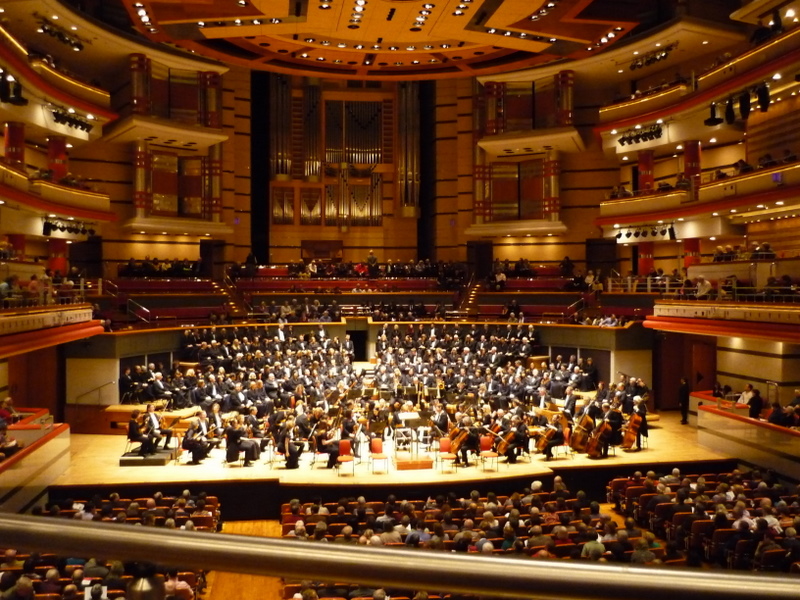
It was like that yesterday at the Symphony Hall in Birmingham. It’s a fabulous hall within a big conference centre. The acoustics are such that if someone clears their throat, you can hear it quite clearly all over the hall, which is why people with coughs should do the decent thing and refrain from attending. But that’s a whole other issue, a tissue issue.
It was Mozart all the way, which is fine by me. The evening kicked off with Symphony No 35 (Haffner). It was a splendid opener, full of colour, bluster and gusto with Andris Nelsons conducting the City of Birmingham Symphony Orchestra.
Andris is a bit of a sensation. He’s only 31, from Latvia originally and played piano, trumpet and sang bass baritone before becoming a conductor. He conducts dynamically using his entire body, leaping into the air, both feet leaving the rostrum, he points, gathers, sooths, softens, punches and grasps. I’m not doing him justice here, making him sound like someone imitating a conductor, but it didn’t seem at all false – pure musical expression.
Mozart can do little wrong as far as I’m concerned but I was under-impressed by the second piece, his Flute Concerto in G Minor. Marie-Christine Zupancic did a fine job on the flute, performing extremely difficult technical solos but nothing about the concerto really moved me. It was interesting to read in the programme notes that Mozart didn’t relish the thought of composing for his least favourite instrument either – though obviously he raised his game to do an outstanding job with the Magic Flute – but probably because the flute solos are very short and simple!
The real deal was after the interval; Mozart’s Requiem. Like many, I was introduced to it by the film Amadeus – screenplay by Peter Shaffer. Although the cinema sound systems do a lot to tattoo the Confutatis on your brain cells, it’s only when you hear the entire work that you appreciate its extraordinary breadth and power.
Yesterday was the first time I’d heard it live. As we took our seats after the interval, the place was electric with anticipation – then precisely on the first beat of the performance, someone hacked out a good loud cough. Great. People had coughed their way through the Haffner and snorted and sneezed in the flute concerto. Suffocation might be the only solution if they dared do that in the Requiem.
The choir began singing “Requiem” and the gathering volume of some two hundred voices filling all the space in the lofty concert hall was properly spine-tingling; the sort of magnificent din that makes you sigh at the beauty of it and bite your lip to prevent uncontrolled falling of tears.
The masses choir turned the first page of music and, contrasted against their dark suits and black dresses, the sudden flutterings of white looked like the wingbeats of hundreds of white doves. It was a good omen.
There’s so much drama in Mozart’s Requiem – the Dies Irae full of sound and fury and later the insistent macho pounding of the Confutatis which dissolves into the soft, heartbreaking feminity of the Lacrimosa, which always makes me think of Michelangelo’s Pieta.
The Requiem experience was akin to drowning in music; letting yourself do nothing but absorb and be absorbed. There was no coughing. If there was, I didn’t hear it but I suspect those with tickly throats were just as helplessly and thoroughly immersed.
Andris Nelsons became a part of it, his conductors hands fluidly caressing spectral bodies in the air, as though shaping and sculpting the sound waves themselves.
After the final long note of the Requiem, there were three clear seconds of silence that were so charged with energy that you could feel the weight of it. Then the applause… which went on and on and was so thoroughly deserved.
It was a faultless, extraordinary performance with a wonderful, wonderful chorus and orchestra plus excellent soloists who had to settle for a vital, yet secondary role in this great work.
If it was such a sorrowful exhilaration for the audience, what must it be like to sing or play in this? One of the highest of highs?
Probably. A pal of mine sings with a well-known Gloucestershire choir and has performed Requiem in a Symphony Hall workshop day led by the charismatic Andris. I asked her once how it feels being part of a massed choir singing a great work. She pressed her fist to her heart and said “Indescribable!”
As we headed out of the building aiming for the lights of the eateries and bars, a couple of men passed us, bouncing along with the kind of gait that smacks of intoxicated celebration. They were members of the chorus, still in their dark suits, still singing excerpts from the performance, drunk on pure choral exhilaration.
.
.

 Boadicea's Chariot
You do the music and the occasion proud.
Agreed – no matter how good the recorded sound system, the atmosphere of a live performance is unbeatable.
Sounds like a great evening Jan – and a wonderful description.
Thanks chaps. Too kind. 🙂
Mrs J and I went to the SH, B’ham soon after it was opened. Marvellous experience.
We used to go there quite a bit when we were in Brum, I can see the hall quite close by from the boy’s flat living room window, that whole complex is only about 5 minutes away. We get a good view of all the fireworks they have there from the balcony.
We are well served in Bellingham for live music, the University has a big music department and a magnificent performance hall. We go to a concert nearly once a week in Oct/Nov/Dec. I have to say that the USA has far more good live music available than does the UK. More musicians are trained here because there are more jobs, many big churches have a large paid music staff, so there is much more music available to the public outside services.
We never bother with Seattle, all PC modern claptrap. If it was composed after Elgar, leave me out!
Glad you enjoyed it!
Lovely
Hi Janus – did you? Fab. Still looks absolutely as good as new – and the acoustics *are* amazing.
So you know it well too, Tina. 🙂 Another nice feature is that the bars are all well organised so it’s not a horrible crush and you get served in plenty of time. A vital ingredient to the whole experience, I think!
Very nice indeed to be able to attend a concert every week! Interesting to hear there is more live music in the US. I can see how the big churches and universities would influence that. There are often lunchtime recitals at Chelters Town Hall, but as I work through lunch-hour, I never get there. It’s also interesting that the Music Festival is the most poorly attended of all the Cheltenham Festivals, which surprises me. Not sure they have the mix/marketing right yet.
Ta, Pseu 🙂
Super, Jan, I agree, I’ve been to SH several times since it first opened, but not recently.
One forgettable occasion included a visit to Le Petit Blanc which was dire; it set the scene and I was so cross I didn’t enjoy the concert.
I’ll leave this for the morning,Jan; a treat with tea and toast. 🙂
You always convey your passion and enthusiasm for life in your writing, Jan. Wonderfully descriptive; I loved “sorrowful exhilaration”.
I used to enjoy the ballet and opera, but, sadly, have never been to a classical music concert.
Lovely post.
That was a pity, Araminta. Another time, eh?
Thanks so much Bilby 🙂 I only tend to write about stuff that moves me in some way, hence the terrible gushy thing.
Goodness, Jan, if that’s a ‘terrible gushy thing’ that you do, we need more of it! 🙂