
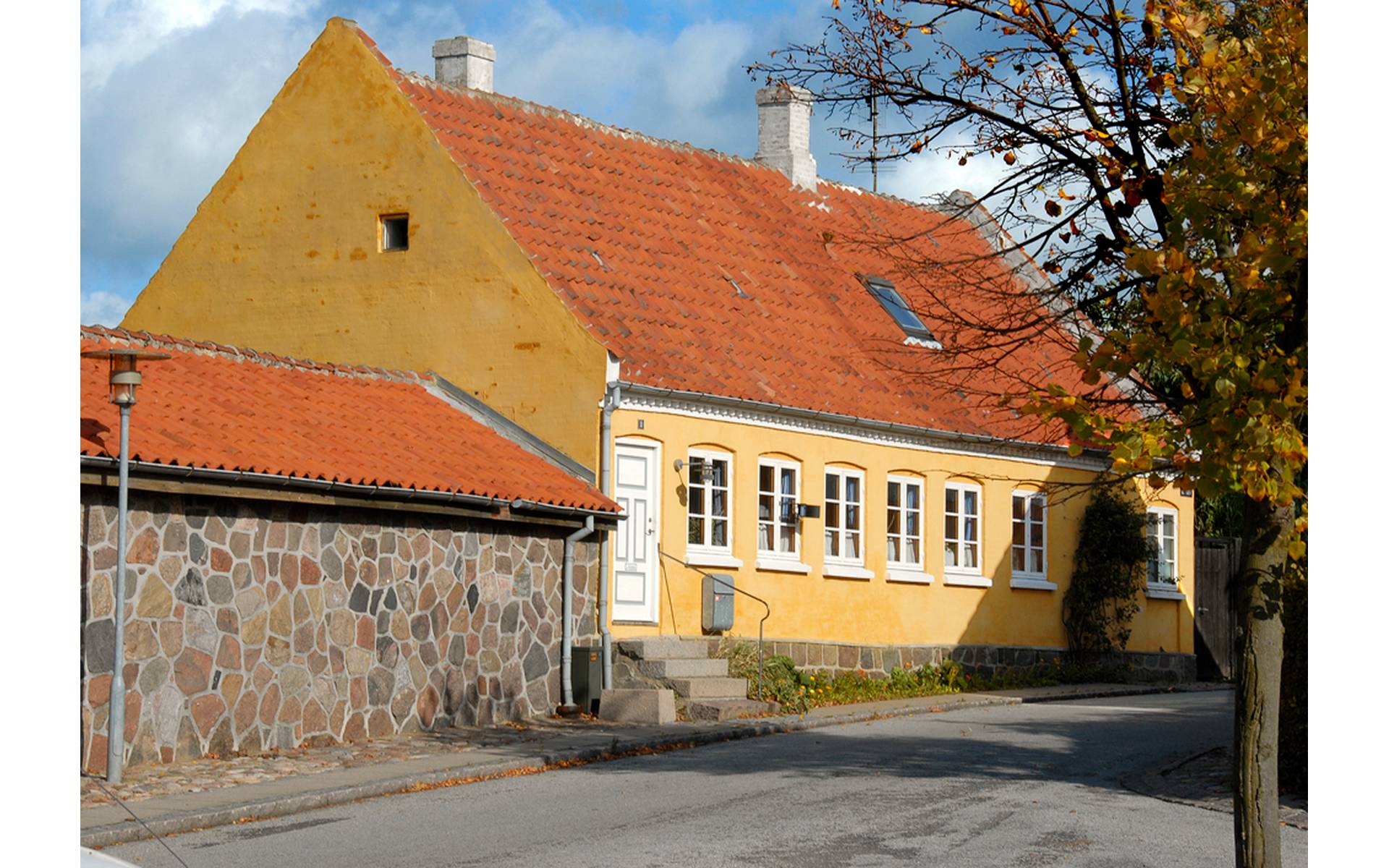
‘Hey, Pancho!’ quoth Don Quixote. Or was that the Cisco Kid? Any road up, the house on the harbour turned out to be a goldfish bowl. Great location but overlooked from every angle and at the mercy of marauding German sailors of a mid-summer’s night. But undaunted our heroes found an 1850 ship-owner’s pad on the town square; big enough for us at 2,000 squ.ft., fully restored and with a glimpse of the sea from upstairs. Its walled garden backs onto the church with the wonky spire. Negotiations in progress.

 Boadicea's Chariot
Best of luck, Janus!
Spooky, Janus! I was just looking up the Cisco Kid the day before yesterday, trying to recall some of the TV programmes from my childhood. ‘Hey Cisco’. ‘Hey Pancho’.
Sipu, what about the Lone Ranger and his trusty friend Silver?
“Hey, Tonto, we’re surrounded by 5,000 screaming Cheyenne. What are we going to do?”
“What do you mean ‘we’? You’re on your own, paleface.”
Good luck, Janus – it looks perfect.
OZ
Nice pad.
Curious windows for a building built as a house, did it have a previous life as a school or something? Walled gardens are nice they keep out a lot of noise.
Just don’t complain about the bells on Sunday morning.
You might just check that the church is not the home of the most manic bell ringing club in Denmark before you buy!
Another thought.
Right on the town square, just like my place in West Wales.
How well do you know this town? If it is a tourist place is the square full of traffic every summer or pedestrianised?
I find that the buses in Wales, which are often there, belch such foul fumes that I never open the front windows only the rear.
Is the house rendered stone, it looks like it?
Good Luck!
CO, no, the house was built by a local trader and the windows are typical of the period, now double-glazed of course. Upstairs has five Velux-type roof lights.
Luckily Danish churches only ring bells for Sunday services and family events! As for traffic, the buses are only allowed at the edge of town and tourism is mostly sailors – without cars!
Yes it’s a fully insulated stone house with a good energy rating.
So far so good.
Sounds good.
One thing about stone is never let the place get cold, takes months to heat up!
I’ve got mine for sale at the moment but instructed the realtor to leave the heat on at 50F.
I have had to move in to others in Wales that had been uninhabited for sometime and nearly froze to death the first three months!!!
I shouldn’t think that effect would be quite as bad with tiles, worse with slate and even worse with rock. I once rented a house with a rock slab roof, every time the wind blew it used to groan and writhe on the ancient oak beams, (1700s) most disconcerting. I used to decamp with the dogs to the living room below for fear of the whole lot about to crush us!
Have a structural survey of the outside rendering before you buy, most important, and damnably expensive to have redone, (don’t ask just don’t ask!) It rarely lasts more than 20 years or so. Especially on a weather wall.
I can imagine hollyhocks all along that wall. 🙂
CO, indeed. The deal here is that there’s a full survey with every house on the market – at the seller’s expense. As you say, rendering can be a devil but this seems OK. The only iffy areas are old tiles and a few punctured window panels.
Nym, yes! They are very popular in these parts.
Good, sounds totally under control. Wasn’t trying to teach egg sucking but very few people have lived in stone houses, not many built after 1880 or so and a good few of them have gone except in out of the way areas.
I’ve lived in more than a fair few and know more than I care to relate of the problems therein!!!
The only other thing that is quite general is a lack of damp coursing. didn’t exist when they were built. Some have been done since with injections but most left to their own devices!
Rising damp is a frequent complaint, helps if you have cellerage at least it tend to go down with gravity!
Only other caveat I can think of is for God’s sakes don’t perforate the walls! Forget venting dryers and cooker hoods, get recirculating ones if they have to be in the main house, the total aggravation of getting through 18″ walls in the first place and then it wrecks the tension of the rendering which decays spider web wise. I was warned off that big time. The Welsh place is in a town right on Milford Sound and takes the weather straight off the Atlantic, generally at 50 mph+, hence the need for the whole town to be rendered! I can see the Irish Ferry docking from my windows.
They do have the wonderful advantage of never getting overheated in Summer, Good luck with it.
PS If you ever get rising damp the only sure way is to French drain the place, injections never seem to last, appear to leach out or get bypassed by the water.
French drain? Wazzat then?
OZ
The Common Agricultural Policy, mayhap!
It appears so
Linkey thing
OZ
CO, a Good New Year to you, Spousal Unit and the hounds.. Greetings from the ‘out of the way area’ of Embra. Most urban dwellers in Jockland and many ruralists live in stone houses. They seem to work just fine for us, damp-wise ( and we do damp big time) with or without rendering, aka harling..
I take it from your comment that you are proposing that, when Hadrians’ Wall is rebuilt, it will have to be in brick with proper coursing. Big mistake! We’ll be through that with our claymores in ten minutes flat, in my opinion.
Janus, a Good New Year to you as well and good luck with the move.
Bad wolf, naughty bad wolf!
Mark you the day you need a French drain in Portugal its all up with the rest of us!
It’s take to the lifeboats!
Might be useful to drain the blood from the BBQ though!!
Sob!!
OZ
JM Edinburgh is built of beautiful workable dressable sandstone and Aberdeen faced with granite. I’m talking about the rougher building of virtually undressed stone two wall and rubble filled! Most of Wales is built like that.
I rather think the house above is of dressed stone as there is no flare or apron to the base, and the pine end does not decrease in width with height, so probably much drier and a better construction if you can get it!
Which type of construction generally relies on what can be quarried locally.
Thanks for all the above observations. As you can see from the pic the foundations are made of hooge boulders which lift the house well above the sources of potentially rising damp. The floors are solid brick on top, recently replaced.
JM, I didn’t realise Embrans could manage ‘ten minutes flat’! 😉
“JM, I didn’t realise Embrans could manage ‘ten minutes flat’! 😉 ”
Nice one, J. Much better than your flowers jibe from the other day. 🙂
As for JM, the three week cut-off period for Happy New Year greetings is over. I will be watching to hope there will be no further well-wishing.
I’m sure he’s wished a few people a GNY more than once just to annoy me.
Management, expect a feud. As usual.
CO, JM: Most of the town where I grew up in South Wales was constructed using the two-wall-rubble-fill technique a process almost guaranteed to wick water as high as the bedroom ceilings. Very difficult to fix, my brother has made a very good living for the last thirty years attempting to do do. One of the results is the alarming difference between the outside dimensions of any house and the tiny cave like interiors, made worse by the deeply recessed windows. Our house was extended towards the rear to build a modern (1960’s modern) kitchen and the concrete support beam for the old outside wall was more than thirty inches thick.
Janus: Sorry to be off topic, good luck with the purchase.