There’s something about abandoned buildings and dereliction. These old dusty places just ooze allure.
This outstanding blog with images, of an abandoned and ruined isolation Riverside hospital on North Brother Island, New York City, once home of Typhoid Mary, made me feel like I was taking a nose around with the writer – and it reminded me how much I love exploring old ruins.
Take a look The photographs are excellent, revealing paraphernalia which was just abandoned. It’s fascinating.
Maybe this interest in the old, ruined and generally a bit crummy stems from those childhood days of exploration and running free in the countryside, finding a tramp’s den in the corner of a field or the ruins of a cottage in the middle of a wood with the big old oak beam over the sitting room fireplace just about the only thing intact amid broken walls.
Maybe it’s something to do with the sheer crumbliness of masonry and the way wildlife sneaks in, unobtrusively at first with moulds and fungus but then takes hold with ferns and flowering plants followed by fantastically grotesque tree roots groping like old men’s hands for grip on failing stonework.
I’ll never forget son no 2′s photos of Angkor Wat in Cambodia. It wasn’t the tourist-covered temples of Angkor itself that captivated me – rather his snaps of the other fantastically romantic ruins still imprisoned and secured by the tropical forest, where roots impale ancient carvings and statues, undisturbed by people or progress.
Perhaps it’s just the combined effects of the passing of time and the way the rigours of the elements are imperceptibly pulling at structures, weakening, wrecking, peeling walls and doors, producing an awesome, ravaged kind of beauty that appeals.
It can’t be merely the discovery, although sometimes that is reward enough. As a family when the kids were young, coming upon a dilapidated deserted chateau in France was the highlight of the holiday. No “Keep Off” signs and plenty of opportunity for clamberings and imaginings.
Venice is my favourite city in the world. It’s big tourist attractions are fabulous and very fine but it’s the unknown quiet bits that I like, where you can get lost and it’s actually quite spooky. Some of the canals are narrow and dark, winding between shuttered ancient buildings which are virtually crumbling into the black water. How splendid are the bright vistas, the cupolas and the basilica but how much more fascinating and atmospheric are the forgotten backwaters.
This, reputed to be Marco Polo’s house, complete with crumbling brickwork.

Another abandoned backwater a lot closer to home is the Stroudwater Canal in the Golden Valley between Chalford and Sapperton. The canal stonework is still there – just – but in places brutally rent asunder by the thick, thrusting roots of ash and hawthorn. Deep in the pit of the canal are a few puddles of water and in the abandoned marshland alongside a moorhen calls from deep within the rushes.
Lock gates are overgrown and unsafe but the walk from Chalford to Frampton Mansell and beyond is one of the most rewarding and beautiful in Gloucestershire. Hot in the summer with butterflies flitting and the thought of snoozy dormice curled up tight in their nests in the hazel thicket across the valley as you rest on the old, warmed stone of an old canal bridge.
Tintern Abbey in the Wye Valley is probably the best known romantic ruin in Gloucestershire. You see it and you understand why Wordsworth was transfixed by it.
Ruskin would know what I’m on about too, although he was very fond of a word which I always think is rather twee and chocolate-boxy; picturesque.
I like his description, although he makes a bit of a meal of it:
“A broken stone has necessarily more various forms in it than a whole one; a bent roof has more various curves in it than a straight one; every excrescence or cleft involves some additional complexity of light and shade, and every stain of moss on eaves or wall adds to the delightfulness of colour. Hence in a completely picturesque object, as an old cottage or mill, there are introduced, by various circumstances not essential to it, but, on the whole, generally somewhat detrimental to it as cottage or mill, such elements of sublimity — complex light and shade, varied colour, undulatory form, and so on — as can generally be found only in noble natural objects, woods, rocks, or mountains. This sublimity, belonging in a parasitical manner to the building, renders it, in the usual sense of the word, “picturesque.”
Such sublimity doesn’t last too long these days. There are no wrecked cottages left in the Cotswolds. They have all been tarted up.
So if you have a yen to explore ruins, you usually have to head for somewhere industrial or buried deep in uncharted territory in the countryside.

A walk near Winchcombe revealed an ancient farm petrol pump, circa 1950′s at a guess, and then, on in the lime green woodland, a stone enclosure with a roof and some tarpaulin over the floor held down by pieces of Cotswold stone.

Beneath the tarpaulin, the remains of a Roman mosaic which once graced a villa on the edge of the woods just near a deep, trickling stream. It was damaged and filthy but a pretty incredible find, especially as it was once walked on by a Roman family – maybe a retired centurion from the Twentieth Legion at Glevum.
The image below is of the “front door” of the Victorian warehouses at Gloucester, part of a fabulously dilapidated High Orchard Street before it was part-bulldozed, part renovated to give way to the Gloucester Quays shopping development.
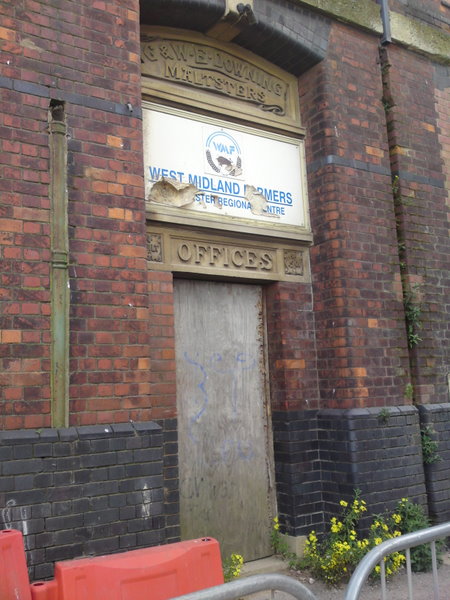
It’s good to record these places, in sketches, photographs or words, before they disappear forever.

 Boadicea's Chariot


What a fantastic post, complete with illustrations. Thanks, janh1.
Marvellous post. Thanks Jan.
I do like this, Jan. Wonderful writing.
OZ
Thanks! 🙂
Great stuff! 🙂
Thanks for the link Jan… I started to reead, but need to go out! Also I find the black background hard to read. Excellent article though.
As is yours, as ever 🙂
Great blog and pics Jan, These old sites evoke the ghosts of the past when you stroll through them. I was in Slima Creek in Malta a few years ago and snuck into the deserted British army barracks there. As I walked around I could almost here the tramp of feet, marching and wheeling on the parade ground to the commands of a long dead RSM.
In a trip of nostalgia, we visited a Victorian castle in the Brecon Beacons a few years ago, with indulgent friends we were staying with, nearby. It is now a hotel, but following the castle owner’s death in the early part of the last century, it was gifted to the people of Wales. It became a Tuberculosis Sanitorium. My mother worked there as a Junior house surgeon in the late 1920s, early 1930s, after qualifying in Edinburgh, and specialising in the treatment of TB at Cardiff. I remembered from my childhood her stories of what a beautiful location it was in, and how patients would be wheeled out onto wide verandahs on their beds, to have as much fresh air as possible; how very bloody lung operations were; and the number of young children as well as miners, who were patients, and the sadness which accompanied the inevitable deaths. The present owner was delighted to take me up a back stair onto an unconverted upper floor. There, still as it had been left, was a hospital ward, large french windows opening out onto a wide verandah, overlooking the beautiful arboretum in the valley below. I have to admit it was one of those rare deja vu moments in reverse, as I could now see for myself what she had been referring to, all those years ago. It was the first time I could visualise her on her daily rounds. The trip which followed to an outbuilding, still marked “Morgue”, completed the picture for me, and emphasised how devastating TB was for the people of Wales in the late 1920s.

The Arboretum from those wide verandahs – eighty years later
Jan – love the pix.
Hi OMG – yes they do! Out of the silence of abandonment come the characters that must have once possessed the place. Evocative. In places like that you can’t help feeling fortunate to be discovering it all afresh.
How *wonderful* CWJ to be suddenly introduced to the scene of your mother’s TB ward rounds and see the view just as she described it! And how sensitive of them to keep it just as it was instead of converting and modernising it. A beautiful spot in clean air – unlike the valleys at that time which were full of terrible poverty and unemployment.
Hi, janh1.
Superbly evocative blog. Thanks for the experience thereof.
Two things. The boy Ruskin. One of the very few people in this world that I am not happy to have to claim as a fellow Jock (born in London but pure Perthshire in lineage). A seriously disturbed individual and completely unsound on Venice, in my opinion, apart, of course, from his description of the ‘Last Judgement’ in Santa Maria dell’Orto.
The second thing, of course, is that it would be no great loss to the world if they bulldozed the whole of Gloucester, in my opinion.
,
I read this post first thing this morning, Jan.
As usual it cheered me up and I didn’t have time to comment, damp leaves and a very neglected garden called.
But, it was exceedingly well written, beautifully illustrated and I followed your link and enjoyed the photographs.
Sometimes, I do feel a little fed up with cyberspace but such posts make me believe it is a fascinating place to be.
Many thanks. 🙂
Morning, Mr Mackie. I liked Ruskin’s sketches but, reading between the lines of the exhibition at his former home at Coniston Water he was indeed disturbed with peculiar tastes. Ah The Last Judgement…haven’t seen it yet. Keeping Tintoretto’s church for next time.
You know Gloucester then? Quite honestly that’s a bit strong, bulldozing the whole of it. You’re forgetting the Cathedral, the Roman remains, Kingsholm, the Docks, Westgate Street including the house where the Commander of the Siege of Gloucester lived. They can bulldoze the rest though, no problem. 😉
Hi Araminta. I have this image of you with long tawny bare legs sitting on the shoulders of some handsome guy in the crowd at Knebworth, long dark hair hanging loose, arms swaying above your head to the music. 🙂 That’s poetic licence for you!
My blog’s nothing like as interesting as the Typhoid Mary hospital blog but yes, coming across that blog makes me think, like you, that the internet can be a mind-altering, entirely enriching experience.