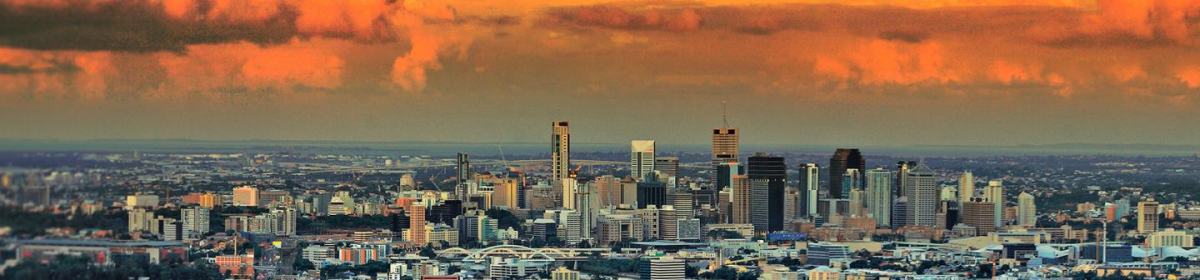
I was only in Sofia for a day, so I didn’t get much of a chance to take photos, but I did snatch just a couple.
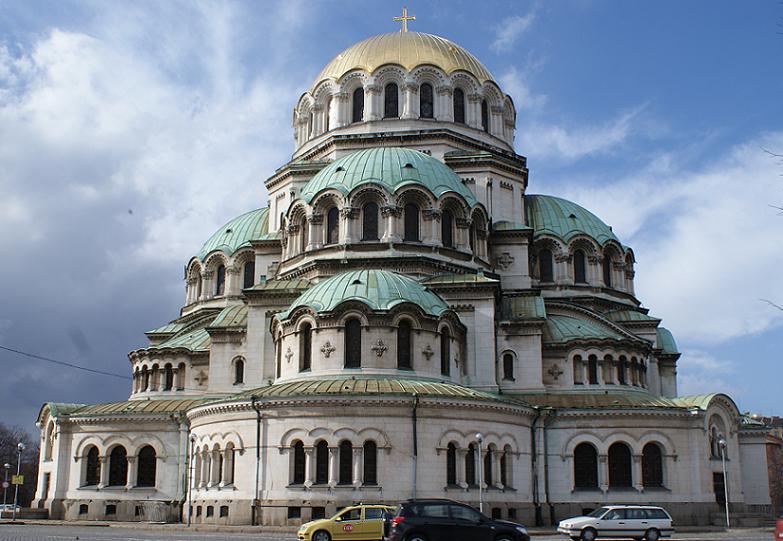
The Alexander Nevsky Cathedral is the biggest Orthodox Church in the Balkans – that’s real gold on the roof…
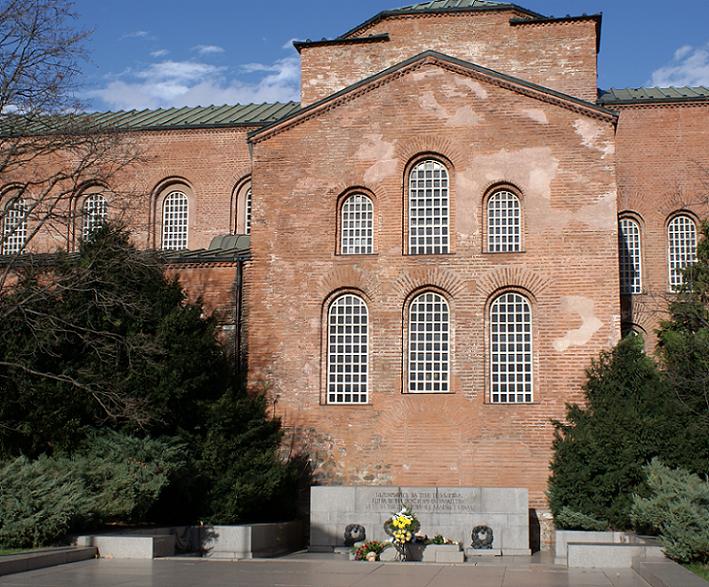
The Church of Saint Sophia was built in the 4th Century – when Bulgaria was still the Roman Province of Thrace! (Mostly.) There are lots of Roman ruins around the church, many of them excavated and to be seen, but I didn’t have tome to look round 😦 Next time 🙂
The tomb of the Unknown Soldier. I thought it was nice to have built it by the ancient church. I was actually shooting the arched windows when I realised what was there.

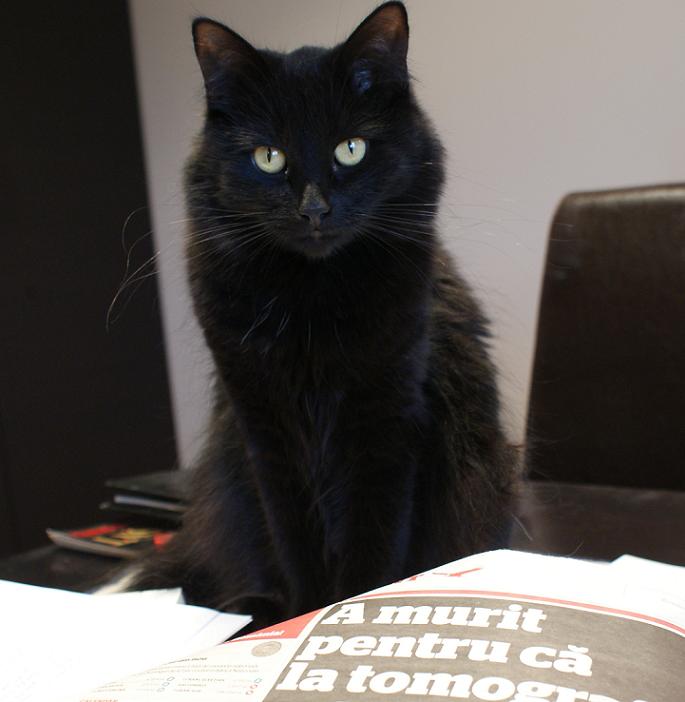
My owner learning to read Romanian with me 🙂
 Boadicea's Chariot
Great photos, Bravo – thanks. 🙂
Lucky, when a black cat crosses your path!
Wonderful photos here Bravo, the cathedral is a lovely building. The tomb of the unknown soldier is delightful too. Thanks for these.
How come the didakois aren’t on that roof nicking the gold?
Ferret
The Paddies beat them to it, nicked the lead and replaced it with gold.
Lucky you, Bravo. Great images!


If you haven’t ever seen gold leaf applied to building surfaces, it comes in very very thin sheets about the size of a paperback, and so flimsy a puff of wind will blow it out of your hand (before it is applied). It is applied to the surface using an artist’s brush. It costs a fortune!
When we built the new HQ in 1985 we started off with the two front entrance pillar tops capped in gold:
The Chairman liked them so much he instructed that the remaining eighteen pillars surrounding the building were to be gold-capped as well! (Budgets are for Bean Counters 🙂 )
CWJ,
Thanks, I am familiar with gold leaf, it is used in wood turning. There must be a pretty substancial varnish on top if that roof was done in gold leaf. It is a very fragile finish.
The same man who ordered these pillars to be capped, also built a very splendid gold-adorned mosque in memory of his mother, which used a similar process. From memory a kind of Plaster of Paris foundation is laid down first. Certainly if it was any more than gold leaf, I would have thought the whole roof would collapse because of the weight which would be involved, but I will check with a fellow who was the responsible architect for the Grand Mosque in Oman, and get back to you. I think you are right that there is something else applied once the leaf has been put on.
However it is done CWJ, it is bloody impressive.
I was going to write that I thought it might have had to have been a bit more substantial than gold leaf. I’ll be interested to find out how it’s done.
The Georgia State Capitol building in Atlanta also has a gold-plated dome. This site gives some of the history. It states that 43oz of gold were used at a thickness of 1/5,000th of an inch, approx thickness of tin foil “used to wrap chewing gum”! It seems the Americans did not possess the same skills as the 4th century Bulgarians since the Atlanta dome has had to be re-plated.
http://www.georgiaencyclopedia.org/nge/Article.jsp?id=h-1148
43 troy oz is 1337.45 gms. There are 19.3 gms of gold per cm3. So, 1,337.45gms would occupy 69.3 cm3 or about 1/14th of a litre, or about 1/8th of a pint. Approx the size of two golf balls. Unless my arithmetic is wrong.
Luckily G Brown was not their leader, he would have sold the gold at a low price.
Good shots, love the cat.
Sipu, effectively what you are referring to is indeed gold leaf – if you breathe out too hard near it, it will flutter out of your hand, so it is gilding the lily somewhat to describe it as gold-plated – more realistically gilt, although I think that imvolves a chemical process possibly.
The front door of the building on my comment was absolutely enormous, made of brass and “gold-plated” with gold leaf. I am convinced that most of the population thought the doors were made of solid gold!
Anyway when my architect friend gets back to me I will pass on whatever information I can glean from him.
My “Fundi” tells me,
Quote:
Re your query on gold leafing of domes I would comment that to apply it externally would certainly require a windless day as the leaf is so thin and light that the slightest breeze would blow it off. The surface required would need to be very smooth (cement render) and then sized for the leaf to applied and then burnished on. However I am not aware of any examples of doing such a treatment externally, we only did gold leafing internally on fiber plaster work. The dome on the Mosque was finished with gold glass mosaic which has a very thin layer of gold vitrified into the surface ( the gold is so thin that when held up to the light the you can see through it but of course once applied to a solid backing the light is then reflected off the gold ). The mosaics are applied with cement based adhesive to a concrete base, and this is I think the most permanent solution.
Unquote
Fascinating CWJ, thanks.