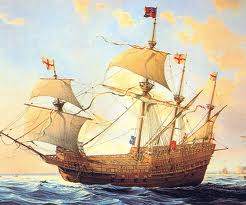
On the 11th of October 1982 the Mary Rose, flagship of King Henry VIII, was raised to the surface after 437 years at the bottom of the Solent. The operation cost £4,000,000.
Launched in 1510, the Mary Rose sank on her way to engage the French enemy fleet off Portsmouth Sound on the 19th of July 1545. Between four and five hundred men perished.
In July 1545 the French fleet entered the Solent with the intention of invading the Isle of Wight and destroying the English fleet. The French fleet was huge, with around 200 ships. The English fleet consisted of around 80 ships, in Portsmouth, with more expected from the west Country. The English aimed to fight a defensive battle, they were outnumbered, but had a positional advantage. The first day of the battle consisted of a long range cannonade between the French galleys and the English fleet in which neither side suffered any real loss. The French had managed to invade the Isle of Wight, tangling with the local militia.
That night, Henry dined on the flagship, Henry Grace a Dieu, with the admiral, Viscount Lisle, as well as Sir George Carew, the newly appointed vice-admiral, and his senior captains. Among the artefacts recovered from the Mary Rose were two pewter plates from Lisle’s dinner service. Quite how these plates found their way onto the Mary Rose is a matter for speculation, perhaps Lisle gave them to his guests as a souvenir of the dinner and forthcoming battle.
There are several contemporary versions of what happened. According to the French, at dawn their galleys took up the battle, trying to lure the English within range of their main fleet. The flat calm allowed them to pound the English ships with relative impunity. Suddenly, much to their delight the Mary Rose heeled over and sank. The French naturally believed they had sunk her.
The Imperial ambassador, Van Der Delft, told a different story. He quoted a Fleming who was a survivor and had told him:
“that when she [The Mary Rose] heeled over with the wind the water entered by the lowest row of gun ports which had been left open after firing.”
Sir Peter Carew, brother of Sir George Carew, newly appointed Vice Admiral in the Mary Rose, gave his biographer, John Hooker, another eyewitness account. He states that the Mary Rose began to heel as soon as the sails were raised. When their uncle, Sir Gawain Carew, sailed past and asked Sir George what the problem was, he answered that “he had the sort of knaves whom he could not rule”. Hooker further says:
“this gentleman…had in his ship a hundred mariners, the worst of them being able to be a master in the best ship in the realm; and these so maligned and disdained one another, that refusing to do that which they should do, were careless to do that which was most needful and necessary, and so contending in envy, perished in forwardness”.
Sir George did not survive.
There have been a number of attempts to explain the loss of the Mary Rose, none of them entirely satisfactory. Perhaps the most likely reason for the loss of the Mary Rose is the most mundane, a simple handling error in the heat of the skirmish with the galleys. Any such problem may have been compounded by confusion or a lack of discipline amongst the crew. The excavation of the ship also revealed that the ballast had shifted to the starboard side, although whether this was a cause or as a result of the ship sinking is uncertain. Once the angle of heel was sufficient for water to enter the gunports the fate of the ship was sealed.
I suppose there are some that would say that to spend money on such projects is a waste of money… what is your opinion?
<i>References: BBC Web-Site and Mary Rose Web-Site
 Boadicea's Chariot
I think that it’s money well spent. You don’t tell us whose money it was, (gov, private, bit of both perhaps)
It is an amazing project which has revealed so much about the way things were. We went down to
see here during the waxing process and I’d love to go again after they have put it all in place
http://www.maryrose.org/new_museum/videoplayer.html
What I loved was the part of the exhibition where you could see the artefacts from the daily life… and I remember a nail they found that hadn’t rusted away as it had fallen in a bucket of tar.
Looks as though it was mainly private donations.
http://en.wikipedia.org/wiki/Mary_Rose_Trust
I keep promising myself a trip to Portsmouth – but never quite make it. 😦
We visited the Mary Rose a few years ago now. Definitely money well spent. As a taxpayer I’m happier that my taxes should be spent on something like this rather than wasted on so many of Brown’s vote buying exercises.
Yep, money well spent in my opinion.
I wonder if the ship was overloaded too? 400 – 50 men, guns and ammuntion, treasure and fancy accoutrements?
baodicea
Do try and get to Portsmouth,spiritual home of the Royal Navy. Apart from the Mary Rose, there is Nelson’s flagship HMS Victory and HMS Warrior which is a cross between sail and mechanical propulsion, there are also other museums, art galleries and exhibits to see. A day very well spent indeed.
A far better spend than on foreign aid!