
 Back safe and sound in “dangerous” California, where the iris and roses are making a tumultuous display in my backyard, I’m looking back at my brief stay in verdant England.
High on the list of pleasures—along with meeting Pseu and Isobel—was my visit to the Birmingham museum where I was able to see the Staffordshire hoard, up close and personal.
The hoard, which is the largest yet found of Anglo Saxon gold, is dated to the 7th and 8th century and consists, as far as anyone has been able to tell, of “warrior bling.” Sword hilts, pommels, bits of helmets; none of it the actual weapons, the blades etc., but rather the decorations. There are a couple of crosses, folded into little packets into which the settings for the crosses’ garnets are tucked.
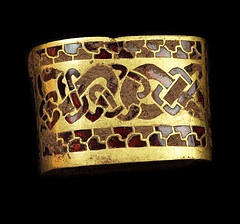
And what decorations! These boys were not modest when it came to gussying up their favorite weapons of mass destruction. A rather pure gold cloisonné inlaid with garnets is the process. A strip of gold would be decorated with gold wire adhered to the base to create the compartments into which were set garnets chipped into the shape of the compartment. And gold foil laid in the bottom of the compartment creates an additional flash of light through the stone. The type of garnet used is apparently not the kind native to Britain so at some point the weaponry will pass through the garnets laboratory at the Louvre in order to determine where the garnets came from: India? Afghanistan? Turkey?
The patterns used are those you’re all familiar with: the intertwining abstractions of leaves and animals that are now often identified as Celtic. What was great, was that the curator was able to point out the excruciatingly fine detailing on the jewelry: the tiny eyes and tongues of the bird-like creatures who were woven together like a chain of paperclips. Things I would have otherwise missed.
The color combination is distinctly Mediterranean, a holdover, I’d guess, from the Romans, who liked the deeply warm combination of gold and red. But appropriate to warriors: the chips of garnet like drops of blood enthroned on a band of precious metal.
http://www.staffordshirehoard.org.uk/
Gold hilt fitting with inlaid garnets
Finds number NLM 449
Birmingham Museum and Art Gallery
 Boadicea's Chariot
Nice piece Jaime.
Garnets are native to the UK, found in Scotland.
Seen them myself in the rocks in the Cairngorms.
For some reason the curator didn’t think these were garnets from the UK. He didn’t elaborate.
An enjoyable read, Jaime. I’d love to see the Staffordshire hoard; another addition to all the things I haven’t got round to since I’ve been back in England. Good to hear you enjoyed your stay here. 🙂
Hi Jamie: I’m glad your trip here went well, and I can imagine you found the Staffordshire hoard interesting. It would indeed be fascinating to found out where these garnets originated.
I love the description of “warrior bling”!
Lovely post, Jaime and are you glad to be home?
Christina, you didn’t read Jaime’s post properly:
“The type of garnet used is apparently not the kind native to Britain …”
An interesting post. Sky TV did a good program about the guy who found it all. Quiet amazing! Here is a live link to the Staffordshire Hoard site.
Bilby, Christina read it correctly, but I changed the main post to reflect her comment. The curator did mention garnets in Scotland. My guess is that they are thinking the garnets came from elsewhere because so much jewelry was recycled by the Romans and from the Romans. But at this moment everything is questions, questions, questions.
My fascination with hoards begins with the Hoxne hoard, which is an opposite to the Staffordshire hoard, being mostly women’s bracelets and domestic items, spoons, pepper pots etc., from the 5th century and therefore more pagan.
Araminta: Glad to be home? Not sure. I’m feeling sort of in-between places and minds these days. You’ll have to ask that question in a couple of months. “Warrior bling” was the curator’s expression. He was very amusing and lively.
Nice to see you back blogging again, Jaime. Thanks for the picture too. I can see why these pieces have caught your imagination
Thanks, Pseu!
Thanks for the explanation, Jaime.
Fascinating read. It’s a bit early in the morning for me look at the web-site – but it looks very informative. 🙂
Hi Jaime, am still vvvv jealous that you saw this!
As I recall, the garnets in the Sutton Hoo find were also thought to be from elsewhere in europe and so one of the things that gets people v excited as it points to trading, and throws the idea of an insular backward people out of the window. Also the male figures between bear like creatures occur quite often in Scandanavian pieces.
I haven’t heard of the Hoxne hoard, Jaime, I will look it up.
Here you go Bilby. This link should be live as well.
Cheers, Toc! 🙂
Wonderful; especially the stunningly beautiful tigress. I do love fertility symbols 🙂
Yes, supposedly there was a mate to the tigress—the other handle to the jug. I was struck by the body chain as well. For metalwork it’s hard to beat the Anglo Saxon Roman period; only the Etruscans seem to outdo them for gold jewelry. Thanks for the link, Tocino.