
Mary Seacole
Much has been written about the Crimean war, numerous accounts point to praise the heroism of Florence Nightingale. One of the sad facts of the war was the many of the soldiers died from Cholera and poor medical attention than died in the actual fighting.
Historians have recorded of the woefully inadequate supplies, military command (as exemplified by the charge of the Light Brigade) was woeful, and the care of sick and wounded patients was barbaric and medieval in its operation. Wounded soldiers regularly had their entire limbs amputated when simple surgery may have sufficed and many soldiers actually died from the medical knife.
It is from this background that historians and the media created a picture of heroism and sacrifice in the name of Florence Nightingale. School text books are replete with stories of the ‘Lady with the Lamp’ and her devotion.
Yet there was another, whom I am of the opinion was (and remains) overlooked and again I am of the opinion this is on the basis of colour.
ENTER – MARY SEACOLE
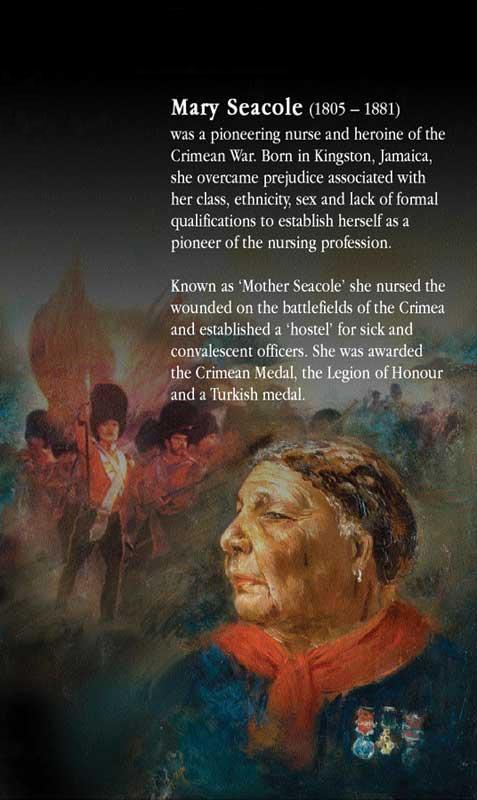
It is my contention that it is Mary Seacole, not Florence Nightingale who is the true heroine of the Crimean war. Indeed, it has been argued, Mary Seacole suffered racism at the hand of the English public, and from Nightingale herself when she refused to include Seacole in her team of nurses heading out to Scutari. Nightingale was born to privilege and wealth. She had powerful friends including Queen Victoria with whom she corresponded regularily. Her nurses have reported that she was querulous and domineering and that her fame came not so much from her nursing (more soldiers died while she was in the Crimea than after she left), and that her great achievement was not so much the advancement of medicine as her own public relations of self worth. It has been shown that many other the reforms attributed to her were in fact already in the process of being implemented by the army itself.
WHO WAS MARY SECOLE
A black British woman, Mary Seacole was born in Kingston, Jamaica, at that time a slave society. Although technically ‘free‘ being of mixed race, Mary’s family had few civil rights – they could not vote, hold public office or enter the professions. However, the ban on women in the medical profession did not prevent many from practising their traditional skills outside of the mainstream, as did Mary’s mother. She was well known in her home town as a healer and she taught this Creole medicine to her daughter – covering the treatment of wounds, diseases and minor ailments.
Fired by a passion for travel, Mary as soon as she was able took off on an extensive journey round other islands visiting Cuba, Haiti and the Bahamas, as well as mainland America and England. On these travels she expanded her knowledge to include European medical ideas which she added to her already existing knowledge.
The Crimean war gave her an opportunity to utilise her talents for the benefit of others but Mary Seacole faced racism in her attempt to join the official group of nurses under the supervision of Florence Nightingale. Fed up with the barriers being put in her way, Mary funded the 3,000 mile journey herself and made her own way to the Crimea where she set up a ‘British Hotel’ to provide clean, nourishing food for both soldiers and officers, to raise the money to enable her to continue her medical work.
Whereas Florence Nightingale and her nurses were based in a hospital several miles from the front, Mary Seacole treated her patients on the battlefield. On several occasions she was found treating wounded soldiers from both sides while the battle was still going on.
Mary Seacole was awarded medals in commemoration of her work with the soldiers of all nationalities by medals from Britain, Turkey and France.
After the war she returned to England destitute and in ill health. The press highlighted her plight and in July 1857 a benefit festival was organised to raise money for her, attracting thousands of people. Later that year, Seacole published her memoirs, ‘The Wonderful Adventures of Mrs Seacole in Many Lands’.
Seacole died on 14 May 1881.
Sadly, after her death, her name was all too quickly forgotten by the establishment, reflecting an all too deeply held racism, sexism and classism in its choice of individuals felt worthy of a place in history.

 Boadicea's Chariot
Not entirely forgotten Kev:-
http://www.maryseacole.com/maryseacole/pages/places.html
Tocina, sorry I should have been more precise. She was all but forgotten until fairly recently
I know that Kev, I just having a little fun. I’m sure that you are right on as to why she was airbrushed out of history.
Thank you for this. Very interesting read.
Kev – I am ashamed to admit I had never heard of the lady until now. Thank you for the enlightenment.
OZ
There is a documentary about her life. I think it may have been aired on Sky TV at some time or other? You can find it here if you are interested’
Thanks Kev, I hadn’t heard of her either but I agree that she sounds as though she should have a rather more prominent place in history.
As you so rightly say though, Florence although well-connected had a battle on her hands to even try to break through conventions, and her motives may well have been debatable and her contribution more so, so how much harder must it have been for Mary.
Thanks Kev.
I’m not so sure that she was totally ignored during her life-time: she was given medals for her work, the press did highlight her plight and people turned out to help her. And in 1881, she was living in Paddington, and described as being of Independent means. But you are absolutely right – she was ignored by the white middle-class writers of ‘Our Island Story’.
This also turned up in my internet wanderings, which shows that her fame had spread back to Jamaica!
Mary was, without doubt, a hands-on nurse. I tend to see Florence Nightingale’s trips through the wards as being more akin to the ‘lady of the manor – let’s comfort the poor’ than really getting down to the nitty gritty of the disease, wounds and horrors that Mary dealt with.
I’ve attached this picture – which shows Mary as the younger, vigorous woman who set off on her own:
I think Boadicea is probably right about the ‘hands-on’ aspect. In this regard the Sisters of Mercy deserve a mention. They were far more experienced than Nightingale et al., and less choosy about whom they helped.
http://www.igp-web.com/carlow/Sisters_of_Mercy_1.htm
No doubt Nightingale did good work, and no doubt it suited the class-conscious ‘narrative’ of the time to single her out.
The article is very interesting, Brendano – thanks. I see Florence had problems with the Sisters, too!
We won’t let you die of your wounds, but you can die of cholera and typhus…
Nightingale wasn’t all bad though.
“Nightingale was a prolific writer, authoring texts, journals, reports and more than 200 personal letters to accomplish her goals. Her book, Notes on Nursing: What it is, What it is Not, was used as a nursing textbook for decades. It emphasized her focus on the environmental aspects of nursing—pure air, light, cleanliness, pure water and efficient drainage. “Nursing theorists in just the last few decades have been focusing on the patient environment,” says Klakovich. “I once heard a speaker at a convention on this topic say, ‘We’re still catching up with this lady after all these years.'”
As a female in the 19th century, Nightingale was ahead of her time. She was a visionary who saw the big picture and had a clear sense of purpose. Reading from a personal letter written by Nightingale, as cited by Woodham-Smith (1950), Klakovich says, “As early as 1867, [Nightingale] wrote, ‘My view is that the ultimate destination of all nursing is the nursing of the sick in their own homes … but it is no use to talk about the year 2000.’ And look at what’s been happening over the past two decades, with health care reform shifting from acute inpatient care to outpatient and home care.”
In addition, Nightingale knew her own strengths and limitations. She was a master at getting her ideas implemented through other people. “She was politically savvy and knew who to go to to get things accomplished,” says Klakovich, “especially to tap strong men to further the causes she identified.” ”
http://www.phoenix.edu/profiles/faculty/marilyn-klakovich/articles/florence-nightingale-a-nursing-leader-ahead-of-her-time.html
You’re welcome, Boadicea. Yes, I thought it was interesting.
According to Wikipedia, ‘Later in life [Nightingale] kept up a prolonged correspondence with an Irish nun, Sister Mary Clare Moore, with whom she had worked in Crimea.’
The Wiki article also states that ‘Her admirers include Country Joe of Country Joe and the Fish, who has assembled an extensive website in her honour’.
I met Country Joe McDonald once on a train journey, and he told me about this. His wife is a nurse, and he is keen to see that nurses get the recognition they deserve. He also campaigns for Vietnam veterans.
Pseu – no one is saying that Florence was bad, just that she seems to have been given all the limelight. One might, reading the history books, be tempted to think that she was the only one doing anything.
One of the most important things that Nightingale achieved was to make nursing ‘respectable’. Discounting the religious orders, nurses at that time had a pretty poor reputation. They were deemed little better than drunk and whores. Mary Seacole could never have achieved that.
The advantage that Nightingale had over Mary was that she had access to the Establishment, and, as you point out, could ensure that the right people listened to what she had to say.