
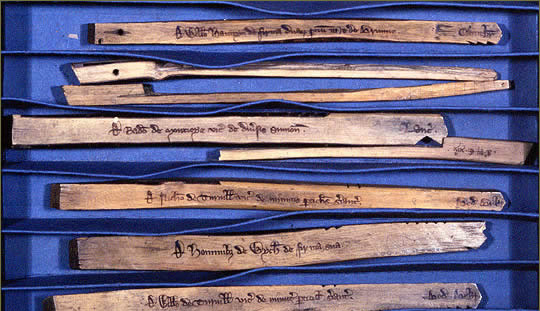
Tally sticks were a medieval accounting device: a peg of wood (usually Hazlewood) was notched with cuts of varying sizes for each denomination of money. It was then split lengthways down the middle into two pieces of unequal length so that each piece had the same notches.
The longer piece, called the stock, was given to a Crown creditor and the Exchequer kept the shorter piece, called the foil.
The Dialogue of the Exchequer, a treatise on how the Exchequer operated (believed to have been written in the late 12th C) explained how they were cut:
‘… the thickness of the palm of the hand, to represent a thousand pounds; then a hundred pounds by a cut the breadth of a thumb; twenty pounds, the breadth of the little finger; a single pound, the width of a swollen barleycorn; a shilling rather narrower than a penny is marked by a single cut without removing any wood.’
As you can imagine, in the early years they would be fairly small, but over the centuries as costs rose, tally sticks could be quite long!
I have only looked at these in relation to tax collections, but the system was the same whether it was taxes or other Crown revenue. When a tax was levied and the tax-collectors had gathered all or part of the money from the little guys (you and me!) a Crown creditor would trot up to the tax-collectors, present their stocks and get paid in cash. The tax-collectors would then present the stocks when they were making their Account at the Exchequer, the two pieces of wood would be put together (tallied) and the tax-collectors’ Accounts would be cleared, along with the payment of small sums inreal money. The documents relating to a tax-collector’s Accounts read along the lines of:
“ x, y, and z collectors of the whatever tax owe £1,000 10s 6d.
Paid by seven tallies £950 3s 2d.
Therefore owe £50 7s 4d.
Received £50 7s 4d.
Et Quietus est”
It was a very easy way to pay creditors without the need for them to travel to London, and stopped tax-collectors (and indeed other Crown officials) from carrying large sums of money to the Exchequer in London.
One of the problems with looking at Medieval Accounts is that the minute a stock was sent to the Creditor, the Exchequer entered the payment on the Issue Rolls. As far as the Exchequer was concerned the debt had been paid…
I trust everyone has spotted the flaw with this system! Creditors, all too often, had to ‘get in quick’ to get their payments, and might have wait a very long time to receive their money. Inevitably, the stocks would be ‘Exchanged’ for cash, so in a way tallies became a kind of currency.
Tallies were used until 1826, and by 1834 it was decided something had to be done about the enormous numbers of tally sticks in store. It was decided to burn them in the furnaces that heated the House of Lords Chambers. The Houses of Parliament caught fire shortly after.
 Boadicea's Chariot
Interesting, Boadicea. Well explained. I knew about the theory but I don’t think I’ve ever seen any actual pictures of Tallies, or physical examples, neither did I realise they were used until the 1800’s.
Thanks Boadicea. It does seem extraordinary that they lasted so long. I take it that each tally was for a specific amount of cash and therefore once a stock and its folio were reunited, they served no further purpose. In other words, they were not used again? You used an example of GP1000 10s 6d. Its unlikely that such a figure would reoccur on a regular basis. Or were they sometimes for generic amounts, such as 100, 200 300 pounds etc? (I cant do the pound sign on my keyboard)
Hold down ‘ALT’, then press 0 1 6 3 on the numeric key pad. Result – £. 🙂
Thanks £. I sort of know that, but the trouble is remembering it. ;-( I need a mnemonic.
Thanks for this Boadicea, I had heard most of it from other places, I also read somewhere that the burning tallies were the cause of the fire that burned the old Houses of Parliament, easy to imagine that the thousands of dry sticks would burn hot.
Have you researched how the “Exchequer” worked? I have seen many references to a chequered (Checkered?) board being used to count tallies but have never seen the details explained.
Sipu: You could try “Oh! 16 ozs.” to the pound” ozs. having three letters
Thanks LW.
LW, Would that board be the descendent of the ones used by Italian Money-lenders; the forerunners of the first banks. (Banco/Macella – A board used for transactions of Florentine/Roman origins).
Paul: I have no idea where it originated, it was a large cloth 10 feet by 15 feet with an array of squares (like a chess or chequer board) hence the name. Tokens were placed on various squares to represent various values. How it worked in detail does not seem to have been recorded. Sounds a bit like an early version of a GUI.
The term Exchequer derives from a huge board which was in effect, a calculating aid. It seems pretty clear that by the end of the 12thC, when The Dialogue of the Exchequer was written, that the name had already been transferred to the institution:
‘Although, moreover, such a surface is called exchequer, nevertheless this name is so changed about that the court itself which sits when the exchequer does is called exchequer’
The Exchequer is described as a court because that in effect was what it was. The Crown official had to make his Account at the Exchequer in person, he would be allowed deductions for whatever tallies he brought in or other expenses, and it was not until he had paid or accounted for everything that was owed that he was discharged.
The Dialogue describes the board thus:
‘The exchequer is a quadrangular surface about ten feet in length, five in breadth, placed before those [who] sit around it in the manner of a table, and all around it it has an edge about the height of one’s four fingers, lest any thing placed upon it should fall off. There is placed over the top of the exchequer a cloth … not an ordinary one but a black one marked with stripes, the stripes being distant from each other the space of a foot or the breadth of a hand… ‘
‘… in the spaces of which heaps of cash are placed…
… in the lower space a heap of pennies from 11 down; in the second, of shillings from 19 down; but in the third, of pounds … in the fourth … of the twenties;. in the fifth, of the hundreds; in the sixth, of the thousands; in the seventh, but rarely, of the ten thousands of pounds…’
Counters were used to substitute for coins, their value depending on which column they were placed in. So if the official turned up with 240 pennies, a counter could be placed in the pound column… Counters would also be used to show the allowances and other deductions.
The ‘calculator’ then did his sums almost like using an abacus… and had to say what he was doing:
‘He must take care, however, lest his too hasty hand proceed before his tongue, or the reverse; but at the same time that he counts he shall place the counter and designate the number… ‘
We take the decimal system for granted, this mob used Roman numerals, and often counted in scores. I’m amazed at how rarely they got their sums wrong…
It was a useful way of accounting and an easy way to pay creditors. Once the stock and counter foil were united – that was it – no further use! If you look at the pictures you will see that they have writing on them – that is the name of the person to whom the stock was given, the sum, and the reason it was given. And yes there were thousands if not hundreds of thousands of the things… it is a great sorrow that they were deemed to be of no value and destroyed.