
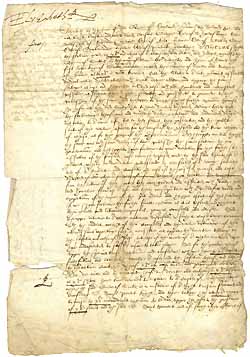
On the 1st of February 1587, Elizabeth I, Queen of England, finally signed the death warrant for Mary Stuart, former Queen of Scots.
On the 19th May 1568, Mary landed at Workington in England. She had fled Scotland after an unsuccessful attempt to regain the throne that she had been forced to abdicate the previous year. Mary said that she sought the protection of her cousin, Elizabeth, but she probably also hoped that Elizabeth would help her regain her crown.
There was a slight problem: Mary had previously claimed Elizabeth’s throne, a claim she refused to renounce, and was considered by some English Catholics to be the legitimate heir. Mary was swiftly taken into custody and never released.
In 1570, Elizabeth was persuaded by Charles IX of France to promise to help Mary regain her throne. As a pre-condition, Elizabeth demanded the ratification of the Treaty of Edinburgh, which amongst other things officially recognised Elizabeth’s title. Mary refused. Knowing Elizabeth, it seems unlikely that she would have helped Mary, but the situation was exacerbated by a Papal Bull of excommunication on Elizabeth and anyone who obeyed her. Elizabeth and her government interpreted the Bull as an incitement to Catholics to withdraw their allegiance and depose Elizabeth and replace her with Mary. Any chance of Elizabeth helping Mary flew right out of the window after that!
There were several Catholic plots designed to assassinate Elizabeth and replace her with Mary. No proof of Mary’s complicity in these plots was found until the Babington Plot of 1585-6. Francis Walsingham (Secretary of State and Spymaster ) and William Cecil (Elizabeth’s chief advisor) knew about the plot to rescue Mary, assassinate Elizabeth, and replace her with Mary almost from the beginning. The letters between the conspirators and Mary were intercepted. Eventually, Mary incriminated herself by agreeing to the assassination of Elizabeth.
Mary was put on trial in October 1585, and found guilty of treason. All that was left was for the warrant for her execution to be signed. Only one person could do that – Elizabeth, and she refused to do so until the 1st of February 1587. She gave the signed warrant to William Dawson, a privy councillor, and later claimed that she only ‘entrusted’ him with it. Whatever the truth of the matter, William Cecil and the rest of the Privy Council, determined to be rid of Mary, acted almost immediately on the instructions to:
‘repair to our Castell of Fotheringhaye where the said queene of Scottes is in custodie and cause by your commaundement execution to be don uppon her person’.
Mary was executed on the 8th of February 1586 at Fotheringay castle.
The original warrant is lost. In 2008, the only surviving contemporary copy was bought by Lambeth Palace Library for £72,485.50.
 Boadicea's Chariot
Boa, I have a vague recollection from school history lessons that a certain Mary was incarcerated in Coventry around this time. Is that true? And is it the origin of being sent there?
PS the locals also heard that:
“St. Mary’s Guildhall is one of the finest surviving medieval guildhalls in England. First built in the 1340s for the merchant guild of St. Mary, it was enlarged between 1394 and 1414 and extensively embellished at the end of the 15th century. Soon after it was built it became the headquarters for the mayor and corporation of Coventry and remained so until the early 20th century when Coventry Council House was built. It served as the centre of King Henry VI’s court during the War of the Roses and as a prison to Mary, Queen of Scots.”
It doesn’t look like it. She was first taken to Carlisle Castle, then to Bolton Castle, Tutbury and then stays in Sheffield and Chatley.
I would not have thought that a Guildhall would have been sufficiently secure, and despite what those who think she was a martyr say, it wouldn’t have been sufficiently comfortable for her. I’ve just read an article complaining that she was held in ‘dank, dark’ confinement!
Addition (I like this facility!) I’ve just checked out the web-site for the building and it repeats the claim. If it was used, and I can’t see them making the claim if it were not true then it would probably have been short-term when she was being moved from one place to another.
Hi Boadicea, I watched, Elizabeth, the Golden Age a couple of days ago. What did you think of it?I was not madly impressed. I thought they squeezed in far too much history, much of which was probably pretty dodgy, with too much personal drama. Either make it entertain, like Shakespeare in Love or make it factual and historically accurate. I did not learn from it nor was I entertained.
Hello Sipu
Sorry to intrude. I’ve just spotted your “About Me” on MyT – and admire your guts. But beware – I’ve expressed similar sentiments in the past, and look what happened …
The reason for busting in is to ask whether I can use a screen capture of your About Me on my own subversive blog:
“A Rough Ride on MyT”
http://www.sciencebod.blogspot.com
I’m posting later this morning under the title :”Fourth of 30 possible reasons why I’ve been locked out of MyT: Kodak Kate?”? It needs a graphic, and yours fits the bill nicely.
Apologies Boadicea…
Sciencebod, I would rather you did not. I am not conducting a vendetta against MyT. They have not harmed me other than to irritate me with their inability to remove spam while at the same time removing far too many decent blogs. My goal is to make Kate and Shane pay attention and recognise the damage they are doing. If they sort things out, I will be happy.
Colin, Isn’t this getting all a bit obsessive. Surely you can just walk away and not let it get you stressed? We know how bad it is, so we move on. What could you possibly hope to achieve?
Fair enough, Sipu. I shall respect your wish. In fact, there’s a fag paper between our two positions, but this is neither the time nor place to dwell on the nuance and the subtleties… 😉
I’m pretty sure this was the ‘history’ of Elizabeth that I started to watch and turned off – after I woke up … 🙂
I’ve more or less given up looking at these sort of programs – what really bugs me is that so often the real story is so far more dramatic than anything a fiction writer can produce.
Colin, same old, same old. Bye bye.
Boa, right. The Coventry archives claim: “Mary Queen of Scots was held in this room between November 1569 and January 1570 on her way down from Tutbury.” Just a couple of months in rather pleasnt surroundings; a privilege not granted to all those sent to Coventry, eh?
Boa
Not that I’m getting paranoid or anything, but I can’t help noticing that your last three blogs have been about chopping the heads off Jocks or blowing them up.
Are you trying to tell me something?
JM, didn’t anybody tell you? This is a Little England Stronghold Site – more is LESS!
Yup thats right Hugh 8)
Little England said the Dane to the Jock on the Aussies blog. 😉
Not at all John! I was going to add a postscript to this asking why you kept sending your rejects across the border, and wondering why those ‘rejects’ were so slow at learning what happened when they upset us…
I’ll leave the 24th of June (1314) for you to tell us what happens when the English went marching over the border with high expectations and over-mighty arrogance…
I promise that tomorrow will be different!
The film starred Cate Blanchette and people raved about it when it came out a couple of years ago. It took me until now to get it out on DVD. But I agree. In many cases reality was more thrilling than the dramatised versions.
Bo, I’ve always wondered if this is where the name of the drink ‘Bloody Mary’ comes from?
To King James VI of Scotland, 14th February 1587
My dear Brother, I would you knew (though not felt) the extreme dolor that overwhelms my mind, for that miserable accident which (far contrary to my meaning) hath befallen. I have now sent this kinsman of mine, whom ere now it hath pleased you to favour, to instruct you truly of that which is too irksome for my pen to tell you. I beseech you that as God and many more know, how innocent I am in this case : so you will believe me, that if I had bid aught I would have bid by it. I am not so base minded that fear of any living creature or Prince should make me so afraid to do that were just; or done, to deny the same. I am not of so base a lineage, nor carry so vile a mind. But, as not to disguise, fits not a King, so will I never dissemble my actions, but cause them show even as I meant them. Thus assuring yourself of me, that as I know this was deserved, yet if I had meant it I would never lay it on others’ shoulders; no more will I not damnify myself that thought it not.
The circumstance it may please you to have of this bearer. And for your part, think you have not in the world a more loving kinswoman, nor a more dear friend than myself; nor any that will watch more carefully to preserve you and your estate. And who shall otherwise persuade you, judge them more partial to others than you. And thus in haste I leave to trouble you: beseeching God to send you a long reign.
Your most assured loving sister and cousin,
Elizabeth R.
It does seem that Elizabeth was most reluctant to condemn Mary, but I don’t see how it would be possible to excuse the plots. There again, she would say that, wouldn’t she? She was something of a loose cannon, though.
Its interesting that she does not acknowledge that Queen Mary was the mother of her ‘dear Brother’, King Jame VI. I would imagine the letter was written by Walsingham. Having arranged for the elimination of Mary, he was now faced with the prospect of having King James succeeding Elizabeth which would have put his own life in jeopardy, especially if Good Queen Bess’s demise occurred sooner rather than later.
Thanks for this Araminta.
I’m sure Elizabeth was reluctant to execute Mary. Elizabeth (like all monarchs) made a great point of saying that she was ‘set apart’ because she was an anointed queen, so it made it rather difficult to disregard Mary’s position. And, of course, Mary did say that no one could judge her because she was ‘above the law’ being a queen.
I’m pretty sure that this is where the idiot idea of not killing the enemy’s Head of State comes from. I believe that Churchill refused to countenance the assassination of Hitler. Daft notion, in my view!
Realistically yes, Boadicea, but once you countenance this sort of removal of a head of state, you weaken your own position, so I can see the reluctance, particularly in Elizabeth’s case as you say. It sets a dangerous precedent.