
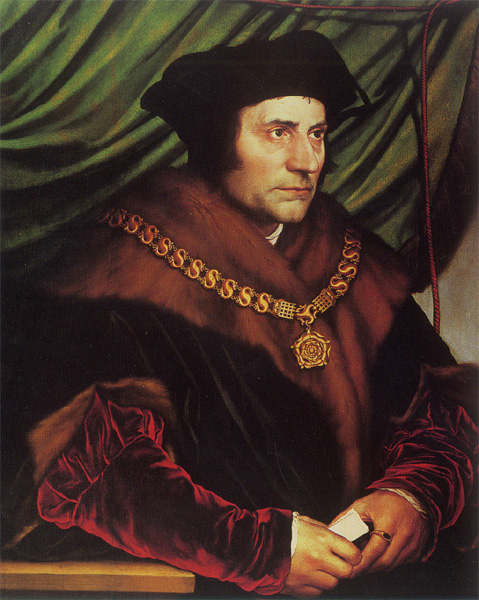
Some time between 2 and 3 on the morning of Saturday the 7th of February 1478, Thomas More was born in Milk Street London. He was the only surviving son of Sir John More, a lawyer, and Agnes Graunger. Thomas described his family as being ‘non celebris sed honesta’. Thomas was to change that…!
Thomas was educated at St Anthony’s school in Threadneedle Street, and at thirteen he was placed in the household of Thomas Morton, Archbishop of Canterbury and Lord Chancellor of England. On the Archbishop’s recommendation, Thomas was sent to Oxford. Apparently Thomas’s father kept his son short of funds so that ‘he had no opportunity of neglecting his studies for frivolous amusements’. Some of us can’t imagine Thomas as being ‘frivolous’, but he was described as a ‘merry fellow’!
Thomas studied Greek, the Classics, French, mathematics and history. His father feared that Thomas’s enthusiasm for what was termed “The New Learning” would compromise his religious orthodoxy and removed Thomas to Lincoln’s Inn where he studied law. John More’s next concern was that Thomas might forsake law and become a monk. Thomas lived for some years in the London Charterhouse, wore a hair shirt, scourged himself and gave himself a few hours sleep. Although he eventually became involved in secular affairs, Thomas continued to wear a hair shirt and scourge himself.
Thomas married Jane Colte, the eldest of three daughters, in 1505. It is said that he fell in love with the middle daughter, but married Jane because he considered ‘that it would be both great grief and some shame to the eldest to see her younger sister preferred to her in marriage’. The couple had three daughters and one son. All of Thomas’s children were well educated, but his especial favourite was his oldest daughter, Margaret. Jane died in about 1511 and Thomas married a widow, Alice Middleton.
Thomas lived in ‘interesting times’. He was born in the reign of Edward IV, he was five when Richard III took the throne, and seven when Henry VII became King of England.
Without going into all the details, Thomas came to the notice of Henry VIII, not only as a Crown official but also as a friend. While Thomas often wrote about Henry’s affability, he had no illusions about his sovereign and told his son-in-law that if his head would win Henry a castle in France – his head would go.
By the early 1500s the Catholic Church and some of its practices were being publicly criticised and condemned. More was in sympathy with many of these views, but condemned those, like Martin Luther, who removed themselves from the Church. More wanted the Church to reform itself. Henry VIII asserted that More persuaded him to write ‘Defensio Septem Sacramentorum’, whether that is true or not, I don’t know, but certainly Thomas wrote a lively (and occasionally vulgar!) testimony of his faith in the Papacy.
Thomas was made Chancellor of England after Wolsey’s fall in 1529. He was the first layman to occupy the office. He was, by that time, well aware of Henry’s intention to have his first marriage annulled, and had made his position clear. He was pro-Catharine and pro-Papacy. He was also against Henry’s suggestion that the laws against heresy should be relaxed. His tenure of the Chancellorship was noted for the speed and impartiality with which cases were heard. Not even relatives got favourable verdicts.
More is often remembered for his book ‘Utopia’. In that book he stated that Utopians only insisted that no one should deny the existence of God, and that none should criticise another’s belief. Utopia was one place, England was another. Thomas hated heretics with a passion and persecuted suspected heretics with a vengeance.
Thomas resigned the Chancellorship in 1532 and lived in retirement from public affairs for over a year. In 1534 Parliament passed a bill requiring an Oath to the new succession. Thomas was prepared to take that oath, but not one that acknowledged Henry’s Supremacy of the Church of England. He was imprisoned and tried for treason. He was found guilty, and sentenced to be hung, drawn and quartered. The sentence was commuted to beheading, and Thomas was executed on the 6th of July 1535. He was canonised in 1935.
 Boadicea's Chariot
Thank you Boadicea. I remember being taken to see a Man for All Seasons by my mother when I was a boy. I know that I missed much of its significance, though I do remember the axe coming down and then, blank.
You make it clear that Thomas More supported the Papacy. I often think it would be very interesting to hear people from history, i.e. people like More, defending their beliefs, whether they be political, cultural or religious. There are many who would find it idiotic to even contemplate the power that the Papacy held over many European realms, but More, an intelligent, educated and apparently deeply moral man believed it to be right. Today we have the ‘benefit’ of hindsight, but he had the benefit of being a first hand witness to events. While I do not doubt that his arguments exist somewhere in written form, there is probably much that has been left unsaid. Much would have been taken for granted that we today cannot really appreciate.
Thomas More does seem to be one of the more attractive characters of the period, Boadicea and he is described by Erasmus as so.
“I find here a climate at once agreeable and extremely healthy, and such a quantity of intellectual refinement and scholarship, not of the usual pedantic and trivial kind either, but profound and learned and truly classical, in both Latin and Greek, that I have little longing left for Italy, except for the sake of visiting it. When I listen to Colet it seems to me that I am listening to Plato himself. Who could fail to be astonished at the universal scope of Grocyn’s accomplishments? Could anything be more clever or profound or sophisticated than Linacre’s mind? Did Nature ever create anything kinder, sweeter, or more harmonious than the character of Thomas More?”
Sipu: I believe it was Erasmus who described More as “A Man for all Seasons” and I remember going to see the the film too.
I do wonder about his reputation as an enthusiastic persecutor of heretics though, Boadicea. It doesn’t quite square with the other view of him. I do wonder if it was some sort of smear campaign or conversely, his canonisation meant that this seemingly excessive zeal was overlooked or applauded by the Catholic church.
Araminta, your questioning of More’s motives in persecuting heretics endorses my point about wondering what would he have said about it had he been around. I agree, it does seem odd that he should have taken that route with such enthusiasm. But, if one had access to the thoughts and beliefs that prevailed at the time, perhaps it would not have been so extraordinary. Put it this way, who do you, (or I for that matter) know who would want to attend the burning of a heretic? And yet many people in those days were more than anxious to view such a spectacle.
Point taken, Sipu, it was considered “normal”, and More was a politician. Others, though are on record as being somewhat squeamish about these things but not to go along with it could be a bad career move. I shall try to find out more.
That’s it you two! This afternoon I’m going in the garage to unpack my books! No idea where I’ll put them – but out they come!
Will get back to you very soon!
Hee hee, Boadicea, we are just keen 🙂 You may have missed my comment on another post here earlier, but I have an even bigger problem. I can’t get at my 25 cases of books, so I have to rely on my memory (dire) and Google (frustrating). I’m flying blind and it’s so annoying!
I think it’s very clear that Thomas supported Papal Supremacy from the moment the possibility of Henry taking over was mooted. He was well aware and extremely intolerant of the problems within the church, and apparently wrote some quite witty and, occasionally, vitriolic Latin epigrams. In some ways he (and Erasmus) contributed to the anti-clerical feeling that was rife during the period. But, they both trusted that the higher clergy and education would sort out the problems. Thomas separated the Man from the Office… as I think Catholics still do?
He was also a well known supporter of Catherine: Chapuys, the Spanish ambassador. wrote:’He is an upright and learned man and a good servant of the Queen‘.
I find it somewhat surprising that he took the Chancellorship at such a sensitive time, but he did. He tried to resign in 1531, when Henry tried to get the clergy to acknowledge him as supreme head of the Church (the Act came later), but Henry refused to let him go.
As to his treatment of heretics,it would seem that he separated the Man from the Belief. He wrote to Erasmus that it was their ‘vices not their persons that excited his hatred‘. In his epitaph, he described himself as ‘hereticus molestus‘. He had suspected heretics taken to his house in Chelsea on fairly flimsy charges, and sent them to the Tower to be racked, and authorised the officials at the various prisons to use the harshest of treatment.
His methods were investigated after he left office, but he was acquitted of the charges of acting with undue severity. However, he did admit to having, personally, ordered a boy to be whipped, and of having a madman tied to a tree and beaten into orthodoxy… It seems fairly clear that even his supporters find his personal intervention in heresy cases a little heavy handed.
After he retired, he spent much of his time in religious dispute with Tindal and Frith. I think this tends to show that his persecution of heretics was more than simply ‘Part of the Job’.
There’s no doubt in my mind, that Henry was ‘out to get him’. He was not left in peace in his retirement and, to use a modern phrase, was ‘pulled in’ every time anyone opposed either Henry’s marriage to Anne Boleyn or the Supremacy.
Thomas’s wife, Alice, is reputed to have ‘nagged’ him to take the Oath, but I think (and it is only my personal opinion!) that he was well aware that Henry would find a way to separate his head from his body one way or another.
I didn’t miss your comment, Araminta… I can understand the frustration!
I’m doing my best despite this, but I really have never had any reason to regret the inaccessibility of my books, although the History section is probably nowhere near as extensive of yours, until I joined MyT and now here.
Thanks for the comment above, Boadicea; I will read it again and if I can find anything pertinent to add to it, I shall return.
Please do!
Thanks Boadicea, I appreciate your response and the research that went into it. It is inevitable, I suppose that any great man in a great position is going to face conflicts of conscience at some point. He would have to be almost psychopathic to be totally at ease with every decision or position he has to take.
I hope you have enough bookshelves.
You’re welcome, Sipu.
I’d like to see a few politicians today take a stand on their conscience, unfortunately I think too many of them would have a hard job finding a conscience to stand on.
Lack of bookshelves is part of the problem, lack of space to put new ones is the other difficulty. The house is a great deal smaller than our previous one, but I’ll sort something out!